buddhist prayer for animal liberation
if only.....
Music by Choyling Drolma and Steve Tibbetts. - Songs "Chenrezig" "Padmesambava"
Prayer for Liberation for Our Brother & Sister Animals.
May all sentient beings in the animal realm
subject to unbearable pain in labs throughout the world
be free from suffering.
May alternatives to animal experimentation and testing
be used immediately.
May Bodhicitta fill the hearts of those who imprison them.
May all sentient beings from the animal realm
who suffer endless days, months, years
locked in tiny cages unable to move, be filled with peace and calm.
May the many billions waiting in slaughterhouse lines be free of fear.
May the hearts of those who work in abattoirs
be filled with Bodhicitta so the very thought of harm is purified.
May they never kill again and may the slaughterhouse lines become immediately empty.
May no animal be afraid or depressed.
May their bodies be free of injuries, disease and illness.
May those who need homes, or who have been driven from them
find shelter, plentiful food & water.
May there be liberation for those
tortured for fur, entertainment or who are hunted.
May those who believe they are superior to our brother & sister animals
develop perfect equanimity.
And may they realise in their hearts
that all sentient beings possess Buddha nature
And they are not ours to kill or exploit.
May the many billions of land and sea dwelling sentient beings
who are abused, exploited and killed due to greed, hatred and ignorance
be free of suffering
May they experience complete and perfect enlightenment,
through the virtue of my efforts and prayers.
May I be a voice for the voiceless.
In short, may all human and non-human sentient beings
live together in harmony, peace and equanimity
and achieve perfect Enlightenment quickly.
Composed Feb 14, 2007 by Liberation for Our Brother & Sister Animals. http://www.lobsa.org
To help our brother & sister animals -: Go Vegan/Join your local animal rights group & become active/Don't buy animal products, find alternatives/Don't buy products tested on animals.
Sign US Animal Bill of Rights (international signatures welcome)
http://www.aldf.org/billofrights/index.php
Wednesday, April 11, 2007

Monday, April 09, 2007
Saturday, April 07, 2007
chinchilla-o-rama

I had to go to PetCo yesterday because the dogs were running out of their dry food. Thankfully, the kibble we feed them is not on the huge list of recalled foods. Besides, all those foods that were recalled were derivative of animal by-products and my dogs are vegan. They had been vegetarian but I've been baking their treats for them, as opposed to purchasing over-priced "vegetarian" treats. Now, I can control what goes into those cookies and they're definitely vegan :)
Anyway, as part of their daily diet, we feed them Avo-Derm Vegetarian kibble and wet-food and you can only buy that at PetCo. While there, I decided to find some squeaky toys for Otto but found none that I thought he would enjoy.
I found myself drawn to the rodent area, after talking to the birds, and found two chinchillas!

I have never seen them up close and, to be honest, don't recall seeing them in photos either. I've only seen their pelts once they've been made into coats :(
They were adorable! If I didn't have four dogs, I'd definitely buy one for a pet. I couldn't tear myself away from their cage. I was marvelling at what sweet little creatures they were, with such long whiskers. It made me sad to realize that they are killed to make ugly coats. Apallingly, it takes 200 chinchillas to make one coat. Fucking Madonna and J-Lo.

I took a few pics with the camera on my cell phone but I haven't uploaded them yet. However, I did google chinchilla images and found out quite a bit about them. For instance, they can live up to 15 years and have an agreeable nature.
These two sites, one French and the other Croatian were very interesting, regarding chinchillas raised on fur farms in Croatia. Who knew?

a chinchilla killed (by electrocution) for her fur
I really hate fur coats (except on the animals they belong to) and the people who wear them.
Why can't this fashion choice be abolished forever? No one really needs to wear fur these days yet they continually choose to perpetuate this barbaric practice. And, right now, I'm thinking of the remaining baby harp seals who are being hunted down, at this very moment, in Canada's St Lawrence region. Apparently, there was an ecological disaster in that the ice floes melted quickly and thousands of newborn seals drowned in the icy waters. Yet, shockingly, the Canadian government still okayed the hunt! WTF? Every seal the hunters/murderers see, they are killing! It's absolutely mind-boggling. Who the fuck is requesting seal fur and why the fuck do they need to have it? IT.IS.NOT.A.NECESSITY!!
You can learn more about the Canadian seal hunt here and here
As a footnote, I've been on a Sex and the City binge lately and am surprsied at how much fur they wear on that show. It results in me not liking the show so much. Is fur that much of an East Coast phenomenon? As someone who lives on the West Coast, that's how it seems to me. And if that's the case, I'd never want to live there. I'd be too angry everytime I saw someone walk by in the carcass of a dead animal. It's bad enough here....

an image I always see when I think of people who wear fur

I had to go to PetCo yesterday because the dogs were running out of their dry food. Thankfully, the kibble we feed them is not on the huge list of recalled foods. Besides, all those foods that were recalled were derivative of animal by-products and my dogs are vegan. They had been vegetarian but I've been baking their treats for them, as opposed to purchasing over-priced "vegetarian" treats. Now, I can control what goes into those cookies and they're definitely vegan :)
Anyway, as part of their daily diet, we feed them Avo-Derm Vegetarian kibble and wet-food and you can only buy that at PetCo. While there, I decided to find some squeaky toys for Otto but found none that I thought he would enjoy.
I found myself drawn to the rodent area, after talking to the birds, and found two chinchillas!

I have never seen them up close and, to be honest, don't recall seeing them in photos either. I've only seen their pelts once they've been made into coats :(
They were adorable! If I didn't have four dogs, I'd definitely buy one for a pet. I couldn't tear myself away from their cage. I was marvelling at what sweet little creatures they were, with such long whiskers. It made me sad to realize that they are killed to make ugly coats. Apallingly, it takes 200 chinchillas to make one coat. Fucking Madonna and J-Lo.

I took a few pics with the camera on my cell phone but I haven't uploaded them yet. However, I did google chinchilla images and found out quite a bit about them. For instance, they can live up to 15 years and have an agreeable nature.
These two sites, one French and the other Croatian were very interesting, regarding chinchillas raised on fur farms in Croatia. Who knew?

a chinchilla killed (by electrocution) for her fur
I really hate fur coats (except on the animals they belong to) and the people who wear them.
Why can't this fashion choice be abolished forever? No one really needs to wear fur these days yet they continually choose to perpetuate this barbaric practice. And, right now, I'm thinking of the remaining baby harp seals who are being hunted down, at this very moment, in Canada's St Lawrence region. Apparently, there was an ecological disaster in that the ice floes melted quickly and thousands of newborn seals drowned in the icy waters. Yet, shockingly, the Canadian government still okayed the hunt! WTF? Every seal the hunters/murderers see, they are killing! It's absolutely mind-boggling. Who the fuck is requesting seal fur and why the fuck do they need to have it? IT.IS.NOT.A.NECESSITY!!
You can learn more about the Canadian seal hunt here and here
As a footnote, I've been on a Sex and the City binge lately and am surprsied at how much fur they wear on that show. It results in me not liking the show so much. Is fur that much of an East Coast phenomenon? As someone who lives on the West Coast, that's how it seems to me. And if that's the case, I'd never want to live there. I'd be too angry everytime I saw someone walk by in the carcass of a dead animal. It's bad enough here....

an image I always see when I think of people who wear fur
Friday, March 23, 2007
I remember when they briefly disabled this video from being downloaded as it was up for a Golden Globe award or similar. Anyway, now it's back for free viewing.
Please watch and learn.
Earthlings
Earthlings
Please watch and learn.
Earthlings
Earthlings
Monday, March 12, 2007
Bangalore's War against Street Dogs
Joellen Secondo is a U.S-based animal activist focusing on animal issues in India. She has frequently tipped me off to quality stories, and this marks her first guest post for An Animal-Friendly Life.
Bangalore's War against Street Dogs
By Joellen Secondo
Following two fatal dog attacks on children in January and February, there has been an intense and violent backlash against the street dogs of Bangalore in India.
While the death of a child is tragic under any circumstances, given the number of dogs in Bangalore approximately 56,000 and the number of people over 6 million of these incidents are exceedingly rare.
This past week, city officials ordered dogs to be rounded up and brought to shelters. Many were kept in vans for 24 hours without food or water. Some 800 stray dogs have been dumped at local animal shelters. Over 200 dogs caught by the city were deemed diseased or vicious and were killed by injecting chemicals directly into their hearts or clubbing (as reported in a interview with a city employee published by Mid-Day newspaper, which also published a photo of piled-up dead dogs). Other dogs have been killed by angry mobs in their neighborhoods.
Due to a dearth of professional dog catchers, city garbage cleaners had been given the task of bringing in 1,000 dogs a day, but their lack of experience resulted in abusive handling of dogs as well as an inability to meet their quota.
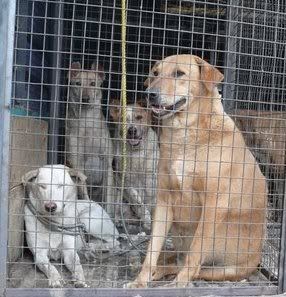
Local newspapers report that the catching and culling will resume in ten days, after the city builds pounds where the dogs can be permanently housed (it is unclear how many or which dogs will be kept there).
The number of dogs killed is tiny compared to the numbers killed in China recently. But what is particularly upsetting is that, up until now, India's progress in stray dog and rabies control has been a model for other countries. The current culling mandate is a foolish step backward and may set a precedent for other municipalities.
Most dogs in India are free roaming. They are community dogs, who live outdoors and belong to neighborhoods or persons who live or work on the streets.
The management of street dog populations in India is critical, not because of the possibility of fatal attacks by street dogs, but because of rabies. India has more human fatalities from rabies than any country in the world, and virtually all are the result of dog bites.
As stated by the World Health Organization, an animal birth control/anti-rabies program (ABC/AR) is the most effective (and most humane) way to: keep dog populations down; prevent dogs from biting (since mating and protection of litters can lead to aggression); and, subsequently, prevent rabies in humans. For 100 years, street dogs were routinely killed in India. Following the passage in 1960 of the Prevention of Cruelty to Animals Act, this has been outlawed; ABC/AR has now become national policy for street dog and rabies control. Now there are calls for the Prevention of Cruelty to Animals Act to be set aside so that all the dogs in Bangalore may be killed.
In many Indian cities, as in Bangalore, animal organizations catch street dogs, spay/neuter and vaccinate them against rabies (putting a notch in one ear to signify that the dog has been sterilized) and then release the dogs back to their original neighborhoods. Since dogs are territorial, they prevent new, unsterilized dogs from moving in.
As proof of the efforts of animal welfare organizations, most of the dogs caught in the recent round-up had been sterilized.
According to Savitha Nagabhushan of Compassion Unlimited Plus Action, one of Bangalore's most active animal welfare organizations,
Stray dogs are a consequence and not a cause of civic problems. The cause is really:
a) The exposed meat shops and their wastes.
b) General garbage piles uncleared.
c) Migrant construction workers who keep dogs and then abandon them when they move on.
d) Uncaring pet owners abandoning their dogs.
e) Unscrupulous breeders abandoning weak and unsold dogs.
It is quite clear that dogs are not the problem, but are victims of humans, of the general population and civic authorities. One incident, however tragic, cannot justify the slaughter of thousands of dogs.
Even though the directive is to capture feral/ferocious/diseased dogs, at the ground level, the catchers will catch only the docile, sterilized, harmless dogs to meet their quota. This will only increase the influx of untreated dogs. This kill the dogs mania is only making the problem worse.
Read her full statement here.
The suburban area in which the two children were killed was cited in 2002 by an animal welfare NGO as high-risk due to numerous illegal butcher shops, which dumped meat waste onto the streets. Dogs gravitated to this highly prized food source. When the butcher shops were closed or penalized for littering, bribes to officials had them quickly back in business.
The government provides some funds for ABC/AR programs to five NGO's responsible for five areas of Bangalore. The area of the dog attacks does not have an ABC/AR program.
The Hindu, one of India's leading newspapers, reported on March 9 that T.N. Chaturvedi, the Governor of Karnataka, castigated city officials in Bangalore and in nearby Mysore for ordering a dog culls, calling it a knee-jerk reaction and requesting a more scientific approach to the problem.
Having spent time in India with animal welfare organizations, I can attest to the dedication and hard work of their staff (who, in many cases, are not even paid). Now, however, all of their efforts and a great deal of the expense that has gone into the sterilization and vaccination of dogs is being undone by voices calling for the killing of street dogs.
Please write to ask authorities to conduct proper waste management and expand the ABC/AR programs. Emails can be sent to the Chief Minister of Karnataka (Karnataka is the state where the city Bangalore is located) and the Bangalore Mahanagara Palike Commissioner, K. Jairaj (this is the city commissioner)
Chief Minister, Government of Karnataka at cm@kar.nic.in
BMP Commissioner: K Jairaj at commissioner@bmponline.org
Letters to the editor can be sent to:
The Hindu at letters@thehindu.co.in
Deccan Herald at editor@deccanmail.com
Photo courtesy of Savitha Nagabhushan, CUPA
Joellen Secondo is a U.S-based animal activist focusing on animal issues in India. She has frequently tipped me off to quality stories, and this marks her first guest post for An Animal-Friendly Life.
Bangalore's War against Street Dogs
By Joellen Secondo
Following two fatal dog attacks on children in January and February, there has been an intense and violent backlash against the street dogs of Bangalore in India.
While the death of a child is tragic under any circumstances, given the number of dogs in Bangalore approximately 56,000 and the number of people over 6 million of these incidents are exceedingly rare.
This past week, city officials ordered dogs to be rounded up and brought to shelters. Many were kept in vans for 24 hours without food or water. Some 800 stray dogs have been dumped at local animal shelters. Over 200 dogs caught by the city were deemed diseased or vicious and were killed by injecting chemicals directly into their hearts or clubbing (as reported in a interview with a city employee published by Mid-Day newspaper, which also published a photo of piled-up dead dogs). Other dogs have been killed by angry mobs in their neighborhoods.
Due to a dearth of professional dog catchers, city garbage cleaners had been given the task of bringing in 1,000 dogs a day, but their lack of experience resulted in abusive handling of dogs as well as an inability to meet their quota.
Local newspapers report that the catching and culling will resume in ten days, after the city builds pounds where the dogs can be permanently housed (it is unclear how many or which dogs will be kept there).
The number of dogs killed is tiny compared to the numbers killed in China recently. But what is particularly upsetting is that, up until now, India's progress in stray dog and rabies control has been a model for other countries. The current culling mandate is a foolish step backward and may set a precedent for other municipalities.
Most dogs in India are free roaming. They are community dogs, who live outdoors and belong to neighborhoods or persons who live or work on the streets.
The management of street dog populations in India is critical, not because of the possibility of fatal attacks by street dogs, but because of rabies. India has more human fatalities from rabies than any country in the world, and virtually all are the result of dog bites.
As stated by the World Health Organization, an animal birth control/anti-rabies program (ABC/AR) is the most effective (and most humane) way to: keep dog populations down; prevent dogs from biting (since mating and protection of litters can lead to aggression); and, subsequently, prevent rabies in humans. For 100 years, street dogs were routinely killed in India. Following the passage in 1960 of the Prevention of Cruelty to Animals Act, this has been outlawed; ABC/AR has now become national policy for street dog and rabies control. Now there are calls for the Prevention of Cruelty to Animals Act to be set aside so that all the dogs in Bangalore may be killed.
In many Indian cities, as in Bangalore, animal organizations catch street dogs, spay/neuter and vaccinate them against rabies (putting a notch in one ear to signify that the dog has been sterilized) and then release the dogs back to their original neighborhoods. Since dogs are territorial, they prevent new, unsterilized dogs from moving in.
As proof of the efforts of animal welfare organizations, most of the dogs caught in the recent round-up had been sterilized.
According to Savitha Nagabhushan of Compassion Unlimited Plus Action, one of Bangalore's most active animal welfare organizations,
Stray dogs are a consequence and not a cause of civic problems. The cause is really:
a) The exposed meat shops and their wastes.
b) General garbage piles uncleared.
c) Migrant construction workers who keep dogs and then abandon them when they move on.
d) Uncaring pet owners abandoning their dogs.
e) Unscrupulous breeders abandoning weak and unsold dogs.
It is quite clear that dogs are not the problem, but are victims of humans, of the general population and civic authorities. One incident, however tragic, cannot justify the slaughter of thousands of dogs.
Even though the directive is to capture feral/ferocious/diseased dogs, at the ground level, the catchers will catch only the docile, sterilized, harmless dogs to meet their quota. This will only increase the influx of untreated dogs. This kill the dogs mania is only making the problem worse.
Read her full statement here.
The suburban area in which the two children were killed was cited in 2002 by an animal welfare NGO as high-risk due to numerous illegal butcher shops, which dumped meat waste onto the streets. Dogs gravitated to this highly prized food source. When the butcher shops were closed or penalized for littering, bribes to officials had them quickly back in business.
The government provides some funds for ABC/AR programs to five NGO's responsible for five areas of Bangalore. The area of the dog attacks does not have an ABC/AR program.
The Hindu, one of India's leading newspapers, reported on March 9 that T.N. Chaturvedi, the Governor of Karnataka, castigated city officials in Bangalore and in nearby Mysore for ordering a dog culls, calling it a knee-jerk reaction and requesting a more scientific approach to the problem.
Having spent time in India with animal welfare organizations, I can attest to the dedication and hard work of their staff (who, in many cases, are not even paid). Now, however, all of their efforts and a great deal of the expense that has gone into the sterilization and vaccination of dogs is being undone by voices calling for the killing of street dogs.
Please write to ask authorities to conduct proper waste management and expand the ABC/AR programs. Emails can be sent to the Chief Minister of Karnataka (Karnataka is the state where the city Bangalore is located) and the Bangalore Mahanagara Palike Commissioner, K. Jairaj (this is the city commissioner)
Chief Minister, Government of Karnataka at cm@kar.nic.in
BMP Commissioner: K Jairaj at commissioner@bmponline.org
Letters to the editor can be sent to:
The Hindu at letters@thehindu.co.in
Deccan Herald at editor@deccanmail.com
Photo courtesy of Savitha Nagabhushan, CUPA
Thursday, March 08, 2007
I noticed that Satya has a new issue out (I'm still not a subscriber, d'oh). So, I read through the free articles and decided to check out the back issues. They have back issues all the way to their premier issue, in 1994! I've been perusing the available articles and am stunned at what I'm reading. Very informational. Here are some of the things I've learned today.
For example, there was an article about punk rock music and animal rights (Oct 95) and this quote caught my attention: "To end the enslavement and the slaughter the antidote is veganism. Don't let your outrage for injustice end where your selfishness begins. I have conquered through self control... A peaceful world can evolve after animal liberation." It's from Earth Crisis who, at the time, was a popular and militant straightedge band (apparently they were described as "New York Vegans", whatever that means).
The song is "Eden's Demise".
I need to start listening to more animal rights-based music...even if I did grow out of hardcore music years ago. It's gotta be better than the shit out there right now.
This article was very informative as well. It aligns itself with my belief that animal testing is outmoded, unsafe, unreliable, and dangerous to humans.
This quote, by Carol Adams, is insightful, People who eat animals are benefiting from a dominant/subordinate relationship, but our culture encourages invisibility of the structures enabling this, and invisibility of the animals hurt by this. Indeed, the animals are seen as unified masses. There is a complete denial of their individuality, so that it is not seen as subordination. We see meat as the ontological reason for animals' existence, that they are there to be eaten. But when you talk about intervening with an ecofeminist care-ethic, one of the things we need to say is, "What are you going through?"
Or finding this out, though I knew that it is standard practice to feed factory-farmed animals other dead animals..mixed in with their feed (and, wtf?, these are herbivorous animals! Why they're being fed flesh is a sickening travesty brought on by the huge demand humans have for animal consumption. Eew): Bovine Spongiform Encephalopathy (BSE) or "mad cow disease." For a number of years, until the late 1980s, British farmers fed their cattle a concoction of animal remains including dead sheep's brains infected, it so happened, with a degenerative disease called "scrapie." Soon, tens of thousands of cows were exhibiting behavior such as disorientation, muscle spasm and collapse, and finally death. Autopsies revealed their brains to be full of holes, like sponges. You are what you eat....
Or this, There is, of course, one final irony. When we have imported the baboon's liver, the pig's heart, the cow's spleen, and whatever else into our body — maybe we'll start recognizing that there's not such a moral difference between human and non-human animals, now that the physiological difference is diminished to almost zero. I doubt it somehow. I agree. I mean, why is it ok to implant animal body parts into our own bodies but still refuse them status as fellow beings? Yes, we're different species but we all live on the same planet, sharing its resources, though we humans have done a bang-up job on gobbling up most of them. Literally.
This article, by Matt Ball, about being vegan is just as true today as it was when this was published, in 1996.
Just like these tips for effective letter writing:
Ideas are powerful. Most of us have opinions and when we feel strongly will spend much time talking about them. But talking is not enough. Doing is what makes activists effective.
Writing letters to the editor is a simple and effective way of taking action. Letters to the editor are powerful tools. The letters section is one of the most widely read parts of a newspaper or magazine. Your letter can reach thousands and even millions of readers. And beyond the cost of a stamp, it won't cost you a penny for typesetting, paper or distribution.
It you need to write 20 letters until one gets printed, it's well worth the effort. And even when your letters are not printed, they alert the editors to readers' interest in an issue. Occasionally a letter can touch a nerve or spark a dialogue which continues for days, weeks and sometimes even months.
It has been our experience that certain steps can maximize your chances of getting that letter printed.
• Before putting pen to paper or finger to keyboard, know exactly what you want to say.
• Whenever possible, bring new information or a fresh perspective to the subject.
• Ideally, you'll address an item which just appeared in a publication. Respond immediately. Don't spend undue time trying to craft the perfect masterpiece. By the time you succeed, editorial interest in the issue may be long gone.
• Let your words ring reasonable, rational, and well thought-out.
• It's okay to be critical, but don't come across as nasty or hysterical. A reasonable tone is usually persuasive, insults are usually not.
• If at all possible, stick to just one issue. It keeps things uncomplicated.
• A well chosen headline can help keep you and your readers sharply focused.
• Familiarity with the letters page will suggest what kind of letters the editors tend to select for publication. Write with this in mind.
• Write as if you're talking to another person and want to hold their interest.
• Keep your language simple. Try to make it flow naturally with short words, short sentences and short paragraphs.
• Avoid trite phrases and clich..s.
If your writing skills are a work-in-progress, consider starting small. It may be a lot easier to get your feet wet with a community paper rather than starting at the top with major national publications.
Once your letter gets published, make copies and circulate them for additional impact. Take advantage of the ripple effect. Encourage your friends and colleagues to do the same. And if your letter doesn't get published, don't give up. Keep trying. A well written letter with something to say will inevitably wind up where it deserves to be. In print!
Or, how to be an activist:
Civil Disobedience (CD) - breaking the law of the day to argue for a greater goal - has been used as a form of activism for many years. Both Gandhi and Martin Luther King, Jr. used it. Ben White lays down some philosophical ground rules for those who feel they wish to undertake CD. The following is not intended as a recommendation to undertake CD; that is entirely a personal decision.
1. Challenging the infliction of suffering is the right thing to do. Feel proud. If you act like a criminal, you will be treated as one.
2. Treat everyone - police, your opponents, the press - as potential converts. Be persuasive, not angry.
3. Be peaceful. Completely. If verbally attacked, smile. If physically attacked, protect yourself without responding in kind. Look the person in the eye.
4. Remember why you are doing it - to keep from personally acquiescing to suffering. The more oppressive the treatment of you, the more obvious the institutional protection of systemic violence.
5. There is power in numbers.
6. Come across as a normal person. Otherwise your opinion is considered by many to be worthless.
7. Know your subject. Don't answer any question from the media that you're not sure of.
8. Appeal to the inherent sense of fairness in your opponent or the police who are encountered.
Tips for preventing burnout:
• Don't mourn, organize! The last words of the great labor organizer Joe Hill before his execution early last century still ring true. Let your sorrow for the victims of oppression fuel your activism. Nothing will change if you are paralyzed by guilt, unending grief and despair. Dwell on solutions, not suffering.
• Campaign to win. Translate your ultimate goal into something you can accomplish today or tomorrow. You can't end all animal abuse today, but you have a good shot at convincing your cafeteria to offer more vegan options. Get involved in an existing campaign—or start one of your own. Choose something you enjoy. Winning even small battles can give you momentum, energy and inspiration to go on.
• Pace yourself. Think long-run. You can't operate in crisis mode all the time. Whatever the issue, you can be sure that it's not the whole world or the last campaign. Take time to pause, listen to your heart, and then act.
• Embrace friends, food and fun. Share your worries and feelings. Celebrate victories. Run your ideas by others. You are not alone! Even people who are not connected with your particular issue can be valuable "reality checks" and sources of ideas and inspiration. Don't neglect yourself, your partner or your companion animals. When adrenaline is high, eat like a fruitarian. When calm returns, feast on luscious vegan food prepared with love and gusto. Sing in the shower, make love, play with your cats, giggle with your kids.
• Move. These days activists spend way too much time behind the computer. Get out of the house and move your body! Hike, bike, walk on the beach, skinny dip, do yoga, stretch. Connect with nature, breathe fresh air, notice the seasons. You will gain perspective and renew yourself for the long journey ahead.
I think I'll buy this book soon. It's called "Dead Meat" by Susan Coe. The link will take you to a review Satya published in June '96. I found this site of her other work, as well.
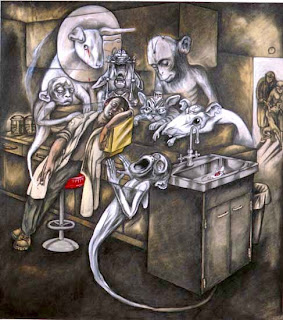
dream, a painting from Susan Coe's series (Graphic Witness)
Another gem from Carol Adams, this article on fur and the homeless. Particularly, her use of this quote from an Indian text:
The Laws of Manu really captures this dynamic: "He who permits the slaughter of an animal, she who kills it, he who cuts it up, she who buys or sells meat, he who cooks it, she who serves it up, and he who eats it, are all slayers." (I have tried to equalize the pronouns.)
So too with fur: the slaughterer, the manufacturer, the retailer, the buyer, the group that donates fur to the homeless, the wearer--are all implicated in the slaughter.
Cow Myths by Angela Starks.
Interesting article on Heifer International. I had stopped buying Seventh Generation because they support them. This article reaffirmed my dislike towards HI. Interesting that it mentions Mary Steenburgen. She is on the latest issue of Delicious Living, available (free) at Whole Foods. And she was pimping Heifer International like it was going out of style. I recall her saying that she suggests people give donations to HI at Bar Mitzvahs, birthday parties, holidays, etc. I threw the magazine in the recyle bin with absolute disgust.
Something I am also aware of, as I do like to sip a glass of wine: not wines are vegan. Here's an introduction to vegan wine, by Catherine Clyne.
Why I feed my dogs a veg*n diet can be explained, partly, by this article. And, it's vet-approved. On the flip-side, there's "natural" pet foods. Not all of them are good.
Some other articles:
What is animal cruelty?
About the actual size......
An interview with Ian MacKaye.
Animal rights and wrongs, by Lee Hall.
Restoring the small farm ethic, with Diane Halverson.
I know I've highlighted mostly animal rights/vegan related topics but Satya focuses on environmental and social justice issues, as well. There was just so much to sift through.
If I wasn't an optimistic person, I'd say our world (or, rather, its humans) are rotten.
For example, there was an article about punk rock music and animal rights (Oct 95) and this quote caught my attention: "To end the enslavement and the slaughter the antidote is veganism. Don't let your outrage for injustice end where your selfishness begins. I have conquered through self control... A peaceful world can evolve after animal liberation." It's from Earth Crisis who, at the time, was a popular and militant straightedge band (apparently they were described as "New York Vegans", whatever that means).
The song is "Eden's Demise".
I need to start listening to more animal rights-based music...even if I did grow out of hardcore music years ago. It's gotta be better than the shit out there right now.
This article was very informative as well. It aligns itself with my belief that animal testing is outmoded, unsafe, unreliable, and dangerous to humans.
This quote, by Carol Adams, is insightful, People who eat animals are benefiting from a dominant/subordinate relationship, but our culture encourages invisibility of the structures enabling this, and invisibility of the animals hurt by this. Indeed, the animals are seen as unified masses. There is a complete denial of their individuality, so that it is not seen as subordination. We see meat as the ontological reason for animals' existence, that they are there to be eaten. But when you talk about intervening with an ecofeminist care-ethic, one of the things we need to say is, "What are you going through?"
Or finding this out, though I knew that it is standard practice to feed factory-farmed animals other dead animals..mixed in with their feed (and, wtf?, these are herbivorous animals! Why they're being fed flesh is a sickening travesty brought on by the huge demand humans have for animal consumption. Eew): Bovine Spongiform Encephalopathy (BSE) or "mad cow disease." For a number of years, until the late 1980s, British farmers fed their cattle a concoction of animal remains including dead sheep's brains infected, it so happened, with a degenerative disease called "scrapie." Soon, tens of thousands of cows were exhibiting behavior such as disorientation, muscle spasm and collapse, and finally death. Autopsies revealed their brains to be full of holes, like sponges. You are what you eat....
Or this, There is, of course, one final irony. When we have imported the baboon's liver, the pig's heart, the cow's spleen, and whatever else into our body — maybe we'll start recognizing that there's not such a moral difference between human and non-human animals, now that the physiological difference is diminished to almost zero. I doubt it somehow. I agree. I mean, why is it ok to implant animal body parts into our own bodies but still refuse them status as fellow beings? Yes, we're different species but we all live on the same planet, sharing its resources, though we humans have done a bang-up job on gobbling up most of them. Literally.
This article, by Matt Ball, about being vegan is just as true today as it was when this was published, in 1996.
Just like these tips for effective letter writing:
Ideas are powerful. Most of us have opinions and when we feel strongly will spend much time talking about them. But talking is not enough. Doing is what makes activists effective.
Writing letters to the editor is a simple and effective way of taking action. Letters to the editor are powerful tools. The letters section is one of the most widely read parts of a newspaper or magazine. Your letter can reach thousands and even millions of readers. And beyond the cost of a stamp, it won't cost you a penny for typesetting, paper or distribution.
It you need to write 20 letters until one gets printed, it's well worth the effort. And even when your letters are not printed, they alert the editors to readers' interest in an issue. Occasionally a letter can touch a nerve or spark a dialogue which continues for days, weeks and sometimes even months.
It has been our experience that certain steps can maximize your chances of getting that letter printed.
• Before putting pen to paper or finger to keyboard, know exactly what you want to say.
• Whenever possible, bring new information or a fresh perspective to the subject.
• Ideally, you'll address an item which just appeared in a publication. Respond immediately. Don't spend undue time trying to craft the perfect masterpiece. By the time you succeed, editorial interest in the issue may be long gone.
• Let your words ring reasonable, rational, and well thought-out.
• It's okay to be critical, but don't come across as nasty or hysterical. A reasonable tone is usually persuasive, insults are usually not.
• If at all possible, stick to just one issue. It keeps things uncomplicated.
• A well chosen headline can help keep you and your readers sharply focused.
• Familiarity with the letters page will suggest what kind of letters the editors tend to select for publication. Write with this in mind.
• Write as if you're talking to another person and want to hold their interest.
• Keep your language simple. Try to make it flow naturally with short words, short sentences and short paragraphs.
• Avoid trite phrases and clich..s.
If your writing skills are a work-in-progress, consider starting small. It may be a lot easier to get your feet wet with a community paper rather than starting at the top with major national publications.
Once your letter gets published, make copies and circulate them for additional impact. Take advantage of the ripple effect. Encourage your friends and colleagues to do the same. And if your letter doesn't get published, don't give up. Keep trying. A well written letter with something to say will inevitably wind up where it deserves to be. In print!
Or, how to be an activist:
Civil Disobedience (CD) - breaking the law of the day to argue for a greater goal - has been used as a form of activism for many years. Both Gandhi and Martin Luther King, Jr. used it. Ben White lays down some philosophical ground rules for those who feel they wish to undertake CD. The following is not intended as a recommendation to undertake CD; that is entirely a personal decision.
1. Challenging the infliction of suffering is the right thing to do. Feel proud. If you act like a criminal, you will be treated as one.
2. Treat everyone - police, your opponents, the press - as potential converts. Be persuasive, not angry.
3. Be peaceful. Completely. If verbally attacked, smile. If physically attacked, protect yourself without responding in kind. Look the person in the eye.
4. Remember why you are doing it - to keep from personally acquiescing to suffering. The more oppressive the treatment of you, the more obvious the institutional protection of systemic violence.
5. There is power in numbers.
6. Come across as a normal person. Otherwise your opinion is considered by many to be worthless.
7. Know your subject. Don't answer any question from the media that you're not sure of.
8. Appeal to the inherent sense of fairness in your opponent or the police who are encountered.
Tips for preventing burnout:
• Don't mourn, organize! The last words of the great labor organizer Joe Hill before his execution early last century still ring true. Let your sorrow for the victims of oppression fuel your activism. Nothing will change if you are paralyzed by guilt, unending grief and despair. Dwell on solutions, not suffering.
• Campaign to win. Translate your ultimate goal into something you can accomplish today or tomorrow. You can't end all animal abuse today, but you have a good shot at convincing your cafeteria to offer more vegan options. Get involved in an existing campaign—or start one of your own. Choose something you enjoy. Winning even small battles can give you momentum, energy and inspiration to go on.
• Pace yourself. Think long-run. You can't operate in crisis mode all the time. Whatever the issue, you can be sure that it's not the whole world or the last campaign. Take time to pause, listen to your heart, and then act.
• Embrace friends, food and fun. Share your worries and feelings. Celebrate victories. Run your ideas by others. You are not alone! Even people who are not connected with your particular issue can be valuable "reality checks" and sources of ideas and inspiration. Don't neglect yourself, your partner or your companion animals. When adrenaline is high, eat like a fruitarian. When calm returns, feast on luscious vegan food prepared with love and gusto. Sing in the shower, make love, play with your cats, giggle with your kids.
• Move. These days activists spend way too much time behind the computer. Get out of the house and move your body! Hike, bike, walk on the beach, skinny dip, do yoga, stretch. Connect with nature, breathe fresh air, notice the seasons. You will gain perspective and renew yourself for the long journey ahead.
I think I'll buy this book soon. It's called "Dead Meat" by Susan Coe. The link will take you to a review Satya published in June '96. I found this site of her other work, as well.

dream, a painting from Susan Coe's series (Graphic Witness)
Another gem from Carol Adams, this article on fur and the homeless. Particularly, her use of this quote from an Indian text:
The Laws of Manu really captures this dynamic: "He who permits the slaughter of an animal, she who kills it, he who cuts it up, she who buys or sells meat, he who cooks it, she who serves it up, and he who eats it, are all slayers." (I have tried to equalize the pronouns.)
So too with fur: the slaughterer, the manufacturer, the retailer, the buyer, the group that donates fur to the homeless, the wearer--are all implicated in the slaughter.
Cow Myths by Angela Starks.
Interesting article on Heifer International. I had stopped buying Seventh Generation because they support them. This article reaffirmed my dislike towards HI. Interesting that it mentions Mary Steenburgen. She is on the latest issue of Delicious Living, available (free) at Whole Foods. And she was pimping Heifer International like it was going out of style. I recall her saying that she suggests people give donations to HI at Bar Mitzvahs, birthday parties, holidays, etc. I threw the magazine in the recyle bin with absolute disgust.
Something I am also aware of, as I do like to sip a glass of wine: not wines are vegan. Here's an introduction to vegan wine, by Catherine Clyne.
Why I feed my dogs a veg*n diet can be explained, partly, by this article. And, it's vet-approved. On the flip-side, there's "natural" pet foods. Not all of them are good.
Some other articles:
What is animal cruelty?
About the actual size......
An interview with Ian MacKaye.
Animal rights and wrongs, by Lee Hall.
Restoring the small farm ethic, with Diane Halverson.
I know I've highlighted mostly animal rights/vegan related topics but Satya focuses on environmental and social justice issues, as well. There was just so much to sift through.
If I wasn't an optimistic person, I'd say our world (or, rather, its humans) are rotten.
Sunday, February 25, 2007
from a bulletin posted on Myspace

Exposing the beast: factory farming must be called to the slaughterhouse
J.M. Coetzee
February 22, 2007
To any thinking person, it must be obvious there is something terribly wrong with relations between human beings and the animals they rely on for food. It must also be obvious that in the past 100 or 150 years, whatever is wrong has become wrong on a huge scale, as traditional animal husbandry has been turned into an industry using industrial methods of production.
There are many other ways in which our relationship with animals is wrong (to name two: the fur trade and experimentation on animals in laboratories), but the food industry, which turns living animals into what it euphemistically calls animal products and by-products, dwarfs all others in the number of individual animal lives it affects.

The vast majority of the public has an equivocal attitude to the industrial use of animals: they make use of the products of that industry, but are nevertheless a little sickened, a little queasy, when they think of what happens on factory farms and abattoirs. Therefore they arrange their lives in such a way that they need be reminded of farms and abattoirs as little as possible, and they do their best to ensure their children are kept in the dark too, because children have tender hearts and are easily moved.
The transformation of animals into production units dates back to the late 19th century, and since that time we have already had one warning on the grandest scale that there is something deeply, cosmically wrong with regarding and treating fellow beings as mere units of any kind.
This warning came so loud and clear that one would have thought it impossible to ignore. It came when, in the 20th century, a group of powerful and bloody-minded men in Germany hit on the idea of adapting the methods of the industrial stockyard, as pioneered and perfected in Chicago, to the slaughter - or what they preferred to call the processing - of human beings.
Of course we cried out in horror when we found out what they had been up to. What a terrible crime to treat human beings like cattle - if we had only known beforehand. But our cry should more accurately have been: what a terrible crime to treat human beings like units in an industrial process. And that cry should have had a postscript: what a terrible crime - come to think of it, a crime against nature - to treat any living being like a unit in an industrial process.
It would be a mistake to idealise traditional animal husbandry as the standard by which the animal products industry falls short. Traditional animal husbandry is brutal enough, just on a smaller scale. A better standard by which to judge both practices would be the simple standard of humanity: is this truly the best that humans are capable of?
The efforts of the animal rights movement - the broad movement that situates itself on the spectrum somewhere between the meliorism of the animal welfare bodies and the radicalism of animal liberation - are rightly directed at decent people who both know and don't know that there is something going on that stinks to high heaven.

These are people who will say: "Yes, it's terrible what lives brood sows live; it's terrible what lives veal calves live," but who will add, with a helpless shrug of the shoulders - "what can I do about it?"
The task of the movement is to offer such people imaginative but practical options for what to do next after they have been revolted by a glimpse of the lives factory animals live and the deaths they die. People need to see that there are alternatives to supporting the animal products industry.
These alternatives need not involve any sacrifice in health or nutrition, and there is no reason why these alternatives need be costly. Furthermore, what are commonly called sacrifices are not sacrifices at all. The only sacrifices in the whole picture, in fact, are being made by non-human animals.
In this respect, children provide the brightest hope. Children have tender hearts - that is to say children have hearts that have not yet been hardened by years of cruel and unnatural battering. Given half a chance, children see through the lies with which advertisers bombard them (the happy chooks that are transformed painlessly into succulent nuggets, the smiling moo-cow that donates to us the bounty of her milk). It takes but one glance into a slaughterhouse to turn a child into a lifelong vegetarian.

Factory farming is a new phenomenon - very new indeed in the history of animal husbandry. The good news is that after a couple of decades of what the businessmen behind it must have regarded as free and unlimited expansion, the industry has been forced onto the defensive.
The activities of animals-rights organisations have shifted the onus onto the industry to justify its practices, and because they are indefensible and unjustifiable except on the most narrow economic grounds ("Do you want to pay $1.50 more for a dozen eggs?"), the industry is battening down hatches and hoping the storm will blow itself out. Insofar as there was a public relations war, the industry has already lost that war.

A final note. The campaign of human beings for animal rights is curious in one respect: the creatures on whose behalf human beings are acting are unaware of what their benefactors are up to and, if they succeed, are unlikely to thank them. There is even a sense in which animals do not know what is wrong - they do certainly not know what is wrong in the same way that humans do.
Thus, however close the well-meaning benefactor may feel to animals, the animal rights campaign remains a human project from beginning to end.
J.M. Coetzee won the Nobel Prize for literature in 2003. This is an edited version of a speech to be given this evening to open the exhibition Voiceless: I feel therefore I am. It will be at the Sherman Galleries until March 10.

To learn more about the horrors and reality of factory farming, click here
italics, bold, and images I have added

Exposing the beast: factory farming must be called to the slaughterhouse
J.M. Coetzee
February 22, 2007
To any thinking person, it must be obvious there is something terribly wrong with relations between human beings and the animals they rely on for food. It must also be obvious that in the past 100 or 150 years, whatever is wrong has become wrong on a huge scale, as traditional animal husbandry has been turned into an industry using industrial methods of production.
There are many other ways in which our relationship with animals is wrong (to name two: the fur trade and experimentation on animals in laboratories), but the food industry, which turns living animals into what it euphemistically calls animal products and by-products, dwarfs all others in the number of individual animal lives it affects.

The vast majority of the public has an equivocal attitude to the industrial use of animals: they make use of the products of that industry, but are nevertheless a little sickened, a little queasy, when they think of what happens on factory farms and abattoirs. Therefore they arrange their lives in such a way that they need be reminded of farms and abattoirs as little as possible, and they do their best to ensure their children are kept in the dark too, because children have tender hearts and are easily moved.
The transformation of animals into production units dates back to the late 19th century, and since that time we have already had one warning on the grandest scale that there is something deeply, cosmically wrong with regarding and treating fellow beings as mere units of any kind.
This warning came so loud and clear that one would have thought it impossible to ignore. It came when, in the 20th century, a group of powerful and bloody-minded men in Germany hit on the idea of adapting the methods of the industrial stockyard, as pioneered and perfected in Chicago, to the slaughter - or what they preferred to call the processing - of human beings.
Of course we cried out in horror when we found out what they had been up to. What a terrible crime to treat human beings like cattle - if we had only known beforehand. But our cry should more accurately have been: what a terrible crime to treat human beings like units in an industrial process. And that cry should have had a postscript: what a terrible crime - come to think of it, a crime against nature - to treat any living being like a unit in an industrial process.
It would be a mistake to idealise traditional animal husbandry as the standard by which the animal products industry falls short. Traditional animal husbandry is brutal enough, just on a smaller scale. A better standard by which to judge both practices would be the simple standard of humanity: is this truly the best that humans are capable of?
The efforts of the animal rights movement - the broad movement that situates itself on the spectrum somewhere between the meliorism of the animal welfare bodies and the radicalism of animal liberation - are rightly directed at decent people who both know and don't know that there is something going on that stinks to high heaven.

These are people who will say: "Yes, it's terrible what lives brood sows live; it's terrible what lives veal calves live," but who will add, with a helpless shrug of the shoulders - "what can I do about it?"
The task of the movement is to offer such people imaginative but practical options for what to do next after they have been revolted by a glimpse of the lives factory animals live and the deaths they die. People need to see that there are alternatives to supporting the animal products industry.
These alternatives need not involve any sacrifice in health or nutrition, and there is no reason why these alternatives need be costly. Furthermore, what are commonly called sacrifices are not sacrifices at all. The only sacrifices in the whole picture, in fact, are being made by non-human animals.
In this respect, children provide the brightest hope. Children have tender hearts - that is to say children have hearts that have not yet been hardened by years of cruel and unnatural battering. Given half a chance, children see through the lies with which advertisers bombard them (the happy chooks that are transformed painlessly into succulent nuggets, the smiling moo-cow that donates to us the bounty of her milk). It takes but one glance into a slaughterhouse to turn a child into a lifelong vegetarian.

Factory farming is a new phenomenon - very new indeed in the history of animal husbandry. The good news is that after a couple of decades of what the businessmen behind it must have regarded as free and unlimited expansion, the industry has been forced onto the defensive.
The activities of animals-rights organisations have shifted the onus onto the industry to justify its practices, and because they are indefensible and unjustifiable except on the most narrow economic grounds ("Do you want to pay $1.50 more for a dozen eggs?"), the industry is battening down hatches and hoping the storm will blow itself out. Insofar as there was a public relations war, the industry has already lost that war.

A final note. The campaign of human beings for animal rights is curious in one respect: the creatures on whose behalf human beings are acting are unaware of what their benefactors are up to and, if they succeed, are unlikely to thank them. There is even a sense in which animals do not know what is wrong - they do certainly not know what is wrong in the same way that humans do.
Thus, however close the well-meaning benefactor may feel to animals, the animal rights campaign remains a human project from beginning to end.
J.M. Coetzee won the Nobel Prize for literature in 2003. This is an edited version of a speech to be given this evening to open the exhibition Voiceless: I feel therefore I am. It will be at the Sherman Galleries until March 10.
To learn more about the horrors and reality of factory farming, click here
italics, bold, and images I have added
Monday, February 12, 2007

Thursday, February 08, 2007

I have always been suspicious of certain types of so-called faux fur and now this: the Humane Society of the United States has been conducting an investigation of several big stores and determined that the faux fur used on coats is actually dog/raccon dog fur from fucking China.
An excerpt follows below:
------------snip---------------------
Dog Fur on Sale
An ongoing investigation by The HSUS has found some of the biggest names in fashion selling raccoon dog fur trim on jackets that were mislabeled, advertised as another species or not labeled at all. The investigation also turned up dog fur on sale.
The HSUS investigation has found:
Dog fur sold online as "faux" by Nordstrom's, Tommy Hilfiger and Bluefly.com. The brands involved are Tommy Hilfiger, Joie and Andrew Marc.
Raccoon dog fur on coats sold online as "raccoon" by Neiman Marcus, Dillard's and Loehmann's (via Smartbargains.com), and as "rabbit" by Bergdorf Goodman and Footlocker. The brands involved were Andrew Marc, Michael Kors, Oscar de la Renta, Bogner and Rocawear.
Misidentified or unlabeled raccoon dog fur sold on jackets by retailers and brands including DKNY, Lord and Taylor, Ross, D.E.M.O, Rocawear, Macy's, Baby Phat, J.C. Penney and Burlington Coat Factory.
----------------snip--------------------------------------
For further details, click here.
The victims
Each year over 50 million animals—including millions of dogs and cats—are killed for their fur worldwide. Although the fur industry does its best to keep the cruelty out of sight, suffering is a common ingredient in all methods of procuring fur, from fur factory farming to trapping. Many, perhaps more than half, of these animals are killed specifically for fur trim—it is not a by-product.
The following are some of the animals murdered for their fur:
Dogs and Cats: Over two million dogs and cats are victims of the fur trade—primarily killed intentionally for their fur, but also injured and killed in traps set for other animals.
Seal Pups: Canada's annual seal hunt is the largest slaughter of marine mammals on the planet. Hundreds of thousands of seals are killed for their pelts each year, with many skinned alive.
Various wild animals: including lynx, bobcats and wolves, suffer and die in traps each year. Countless dogs and cats, deer, birds and other animals—including threatened and endangered animals—are also injured and killed each year by the indiscriminate traps.
Newborn and Fetal Karakul Lambs: Newborn and fetal karakul lambs are killed to make fur labeled "karakul," "astrakhan," "Persian," "broadtail" and other names.
For more details about the vitims and/or to view video, click here
I believe that, one day, fur production will be abolished as it should be. There is absolutely no reason anyone needs to wear it today, except for vanity. Which makes it a heinous fashion choice, in my opinion.
This video shows what happens to the animal whose fur is stripped off just to make a fucking coat or piece of trim. It's barbaric.
Get free stickers at peta2.com
Wednesday, February 07, 2007
This photo, which I saw on another blog las night, is absolutely heart-breaking. And people still go about in their polluting bubbles...........

Click here to take your ecological footprint quiz. Ideally, the planet can only support 4.5 acres per person. I scored at 15 acres and it would take 3.4 planets if everyone lived like me. Sadly, the average in the US is 24 acres per person. Mine would be a lot less if I didn't use my car as much or, at least, had a car with better gas mileage. I currently drive a Honda Element.
And, I should ride my bike more often but this city I live in is not conducive to foot power or bike riding. And the public transport is a joke. If I lived in SF, this would all be a moot point as Mark and I would walk everywhere or take the bus and BART. We have agreed we'd rarely drive our car. Also, he's going to be getting a motorcycle again and I think I'll be getting a Vespa. That should reduce usage of my car.
Here is a list of ways to reduce your ecological footprint:
Transportation
Vehicles that use fossil fuels harm the environment and people's health by creating air pollution.
*Ride or walk to nearby places instead of driving.
*Organize a carpool to get to work or use public transit.
Air Travel
*Airplanes use lots of fossil fuel and contribute significantly to pollution.
*Refrain from vacations in faraway destinations. Take vacations in places nearer to home.
Waste
Throwing things away harms the environment because we use up space to store garbage and also have to produce new materials to replace the ones we threw out.
*Take your lunch to work in reusable containers.
*Separate your garbage for recycling and recycle as much as you can.
*Start composting or worm farming food scraps.
*Think about whether things can be used again for the same or another purpose before you throw them away.
*Give things you do not need to other people or to second-hand stores.
*Buy rechargeable batteries so you do not have to buy new ones.
*Use plastic grocery bags in your garbage cans.
Food
As well as tasting great and being healthy, fruits and vegetables take less space and energy to produce than junk foods, instant foods and meat.
*Try eating more fruit and vegetables instead of junk food.
*Start a vegetable garden so you can grow some of your own food.
*Go to the farmer's markets to buy fruit and vegetables.
*Try to eat meat less often.
Energy
*Turn lights off when you leave an empty room.
*Turn the computer, TV, stereo and other appliances off when you have finished using them.
*Get what you want from the fridge quickly and close the door properly.
*Dry your clothes on a clothesline instead of using the dryer.
*Consider buying electricity from a renewable energy supplier.
Water
Only about 1% of the water on earth is drinkable so it is important to conserve it and keep it clean.
*Turn off the tap when you clean your teeth.
*Take short showers instead of baths.
*Sweep the path or driveway instead of hosing it down.
*Turn taps off properly and if they keep dripping, fix them.
Paper
Paper is made from trees or by recycling old paper, so if we use less we save trees and energy.
*Borrow books from libraries or friends instead of buying them.
*Use both sides of paper for writing or drawing.
*Put a notice on your mailbox saying you do not want any junk mail.
*Reduce the amount of printing at work and save files electronically instead.
Click here to view a series of video tips to reduce your ecological impact.
Most of the sources from this blog entry came from here.

Click here to take your ecological footprint quiz. Ideally, the planet can only support 4.5 acres per person. I scored at 15 acres and it would take 3.4 planets if everyone lived like me. Sadly, the average in the US is 24 acres per person. Mine would be a lot less if I didn't use my car as much or, at least, had a car with better gas mileage. I currently drive a Honda Element.
And, I should ride my bike more often but this city I live in is not conducive to foot power or bike riding. And the public transport is a joke. If I lived in SF, this would all be a moot point as Mark and I would walk everywhere or take the bus and BART. We have agreed we'd rarely drive our car. Also, he's going to be getting a motorcycle again and I think I'll be getting a Vespa. That should reduce usage of my car.
Here is a list of ways to reduce your ecological footprint:
Transportation
Vehicles that use fossil fuels harm the environment and people's health by creating air pollution.
*Ride or walk to nearby places instead of driving.
*Organize a carpool to get to work or use public transit.
Air Travel
*Airplanes use lots of fossil fuel and contribute significantly to pollution.
*Refrain from vacations in faraway destinations. Take vacations in places nearer to home.
Waste
Throwing things away harms the environment because we use up space to store garbage and also have to produce new materials to replace the ones we threw out.
*Take your lunch to work in reusable containers.
*Separate your garbage for recycling and recycle as much as you can.
*Start composting or worm farming food scraps.
*Think about whether things can be used again for the same or another purpose before you throw them away.
*Give things you do not need to other people or to second-hand stores.
*Buy rechargeable batteries so you do not have to buy new ones.
*Use plastic grocery bags in your garbage cans.
Food
As well as tasting great and being healthy, fruits and vegetables take less space and energy to produce than junk foods, instant foods and meat.
*Try eating more fruit and vegetables instead of junk food.
*Start a vegetable garden so you can grow some of your own food.
*Go to the farmer's markets to buy fruit and vegetables.
*Try to eat meat less often.
Energy
*Turn lights off when you leave an empty room.
*Turn the computer, TV, stereo and other appliances off when you have finished using them.
*Get what you want from the fridge quickly and close the door properly.
*Dry your clothes on a clothesline instead of using the dryer.
*Consider buying electricity from a renewable energy supplier.
Water
Only about 1% of the water on earth is drinkable so it is important to conserve it and keep it clean.
*Turn off the tap when you clean your teeth.
*Take short showers instead of baths.
*Sweep the path or driveway instead of hosing it down.
*Turn taps off properly and if they keep dripping, fix them.
Paper
Paper is made from trees or by recycling old paper, so if we use less we save trees and energy.
*Borrow books from libraries or friends instead of buying them.
*Use both sides of paper for writing or drawing.
*Put a notice on your mailbox saying you do not want any junk mail.
*Reduce the amount of printing at work and save files electronically instead.
Click here to view a series of video tips to reduce your ecological impact.
Most of the sources from this blog entry came from here.
Sunday, January 14, 2007
I am absolutely digusted by this article I read, in our local paper. It's actually more of a blurb as animal related items hardly sell. Here it is but you can read more about it here
USDA to inspect hospital after dog's testing, death
Cleveland- The U.S. Department of Agriculture will send an inspector to a hospital where a neurosurgeon demonstrating a medical device to salespeople deliberately induced a brain aneurysm in a dog, which was later destroyed.
The Cleveland Clinic, known for its heart center and for treating high-profile patients such as royalty, said that it had not authorized the procedure. The hospital reported itself to the USDA, which regulates animal testing.
A neurosurgeon caused the brain aneurysm in the anesthetized animal Wednesday at the clinic's Lerner Research Institute in Cleveland to demonstrate a medical device to a group of 20 to 25 salespeople. The large mixed-breed dog was destroyed afterward because of the damage caused by the aneurysm, the clinic said.
The audacity of humans is astounding, to say the least. What do you want to bet that the poor dog was a stray or picked up from a shelter? No one living being deserves to have tests of this kind performed the be "destroyed. Animal testing is bad enough, as results are highly suspect. When I think of mankind's cruelty towards animals, I'm reminded of the tests performed on humans during WWII.
I remember visiting the Dachau concentration camp, in Germany. In the "museum", I came across photos of prisoners being tested on and one series of images were forever engraved into my mind.
 This is one of the photos from that series.
I believe the Nazis were researching high-altitude changes (click here or here for more info) and this particular prisoner is seen in various stages if the experiment until the last photo shown is the one of his death. Heartbreaking....

This photo absolutely blindsided me. The soldier looked as if he was sleeping but was murdered in an inhumane 'high-altitude' experiment at Dachau.
USDA to inspect hospital after dog's testing, death
Cleveland- The U.S. Department of Agriculture will send an inspector to a hospital where a neurosurgeon demonstrating a medical device to salespeople deliberately induced a brain aneurysm in a dog, which was later destroyed.
The Cleveland Clinic, known for its heart center and for treating high-profile patients such as royalty, said that it had not authorized the procedure. The hospital reported itself to the USDA, which regulates animal testing.
A neurosurgeon caused the brain aneurysm in the anesthetized animal Wednesday at the clinic's Lerner Research Institute in Cleveland to demonstrate a medical device to a group of 20 to 25 salespeople. The large mixed-breed dog was destroyed afterward because of the damage caused by the aneurysm, the clinic said.
The audacity of humans is astounding, to say the least. What do you want to bet that the poor dog was a stray or picked up from a shelter? No one living being deserves to have tests of this kind performed the be "destroyed. Animal testing is bad enough, as results are highly suspect. When I think of mankind's cruelty towards animals, I'm reminded of the tests performed on humans during WWII.
I remember visiting the Dachau concentration camp, in Germany. In the "museum", I came across photos of prisoners being tested on and one series of images were forever engraved into my mind.
 This is one of the photos from that series.
I believe the Nazis were researching high-altitude changes (click here or here for more info) and this particular prisoner is seen in various stages if the experiment until the last photo shown is the one of his death. Heartbreaking....

This photo absolutely blindsided me. The soldier looked as if he was sleeping but was murdered in an inhumane 'high-altitude' experiment at Dachau.
Tuesday, January 09, 2007
So, school started again yesterday. I had a 5pm class and had gone to the store once class was over. Usually, I'm ambivalent about checking the snail mail but I am expecting a package from amazon.com so I was highly motivated to see if it had arrived. It didn't :(
On my way to the mailbox, which is 3 houses away from mine, I spotted the friendly pitbull that is tethered in the front yard of the house near the mail box. I said hi to him and petted him and proceeded to check the mail. Out of the corner of my eye, I spotted another dog. She, a cream-colored mixed breed, came to the pitbull and they sniffed each other and seemed to recognize one another. I was curious and wondered if she was a stray so I observed her for a few minutes while trying to make up my mind about what to do.
I noticed immediately that she wore a collar without tags. I swear to God that is something that really baffles me. Why bother to put a collar on your pet if you can't be bothered to put an identification tag on it? I mean, seriously, what's the fucking point???? GAHHH!! That completely pissed me off. It was déjà vu again, what with that evening we spent with Honey a month ago. Same thing with her, a collar yet no tags.
Anyway, I tried coaxing her over to me and she came easily enough but then ran across the street and began lapping up water that was in in the gutter. I followed her and managed to get a hold of her collar and gently led her into my garage. Unfortunately, I had left my garage door open and had locked my car (with the door remote within). The way I parked left barely enough room for both of us to maneuver over to the manual switch. When I got there, I let go of her collar but the noise of the garage door closing spooked her and she ran out. During all this, I was on the phone with Mark and voicing my frustration at the whole situation. When she left the garage, I contemplated, for a brief moment, just letting go of everything and settling in for a relaxing evening. My conscience wouldn't let me and I made up my mind to find her.
The dogs were outside but Otto was still in the house. I grabbed some cookies and a spare leash and proceeded out through the garage. I found her, easily enough. She was back with the pitbull yet, once she saw me, she came over. She stopped in the neighbor's yard and I offered her a cookie, which she took gracefully enough. I hooked the leash to her collar and led her back to my house, closing the gargage door once again.
Otto was a bit scared but the dogs outside were going crazy. I decided not to let them back in for the time being because I didn't want them to overwhelm her nor have her attack them. I let her roam around the house as Otto and I followed her. She seemed friendly enough but too skinny, in my book. Otto seemed very interested in her backside and I think she was in heat. I called Mark to let him know we had another guest and he suggested I take her for a walk, that evening, to see if she would lead me back to her house. I said that I would, if he went with me. Thankfully, he was already on his way home so I did what I could to make our new friend comfortable. I gave her some more cookies, fresh water, and took a few photos of her. She was really striking, in my opinion. I loved her two different colored eyes (one was an icy blue, the other a dark toffee).

a striking beauty, to say the least ^_^
The weather was a bit chilly and I was feeling bad that my three other doggies were still outside and I didn't want to make them wait there til Mark got home so I let them in. It was mayhem until I calmed them down and they were actually decent to the poor stray dog. When Mark arrived, he called me and I led her, through the huddle of four curious doggies, out the front door. We walked down half the block when she stopped in the middle of the road. A SUV pulled up to a house and we thought that maybe they were her humans. We waited until they got out and Mark asked if they were missing a dog. The mother replied that no, she wasn't theirs but she'd been over the day checking out their dog. I thought to myself, she's been running around for two days? And without identification? I could feel myself getting angrier at the stupid people who let her get loose. So irresponsible.
Anyway, one house down, several more to go. I suggested we call it a night and Mark remarked that there was always the no-kill shelter to drop her off at. I was incredulous, to say the least. It was nearly 7:30 pm as it was. No shelter would be open. So, Mark conceded and said she could stay but I had to take her first thing the next morning. I wasn't looking forward to having another stray dog stay the night but I knew it wasn't her fault she was lost and it would be cruel to let her back out. So, we began to head back to our house when the pitbull spotted us and got excited at seeing her. His guardian came out, after the pitbull kept barking, and we asked if he had seen the dog before. He said he had and that the people across the street brought her over to play with his dog. I looked across the street and had noted that some young guy had been hanging out in the front as we walked by earlier. He must've seen us with her but didn't recognize his own dog? I don't know.
We thanked our neighbor and went across the street and asked the kid if this was his dog. He acknowledged that, yes, she was. I felt relief but this wave of anger began to take over. It started bubbling out when he said that "it is always getting out of the yard." I looked at him and replied, "It? It is a she, ok. She is not an it." He looked sheepish but I was on a roll. I remarked on how I found her wandering and that I noted she had a collar but that there were no tags on it. I pointed out that, if he could put a collar on her, perhaps he should pick some tags, as well. He came up with some excuses such as "I know I need to do that but....." Dude, no excuses. If you have an outdoor dog, two things are non-negotiables (in my book) and they are to spay/neuter your pet and put some fucking identification on them. End of story. Jeez.
I realized that I was being a tad bitchy but I can't stand irresponsible people. The kid remarked, at one point, that he didn't know why she kept getting out and I said that it was because she was, more than likely, in heat. And, before I got on my soapbox about spaying and neutering, I decided to end the whole situation. I admitted to the kid that I had no interest in lecturing him but I have four dogs and I can't stand idly by when I see stray dogs wander around without tags. I feel compelled to say something. I mean, really, she could have fallen in to any number of dangerous situations (hit by car, attacked by another animal, taken to the pound, sold to a lab, tortured by another person etc). I think about those things when it comes to my four, all the time. I do not trust anyone as some people are extremely cruel.
As we went back to our house, I felt less relieved and more worried after returning her to her "guardian". I was very agitated once we got home. Mark said he was proud that I didn't lose my temper and that you "have to pick your battles and this one wasn't going to get us anywhere". Also, he said that not everyone treats their pets the way we do and that I just have to accept that. I asked him what's the point then? Why have a pet if you can't fucking take care of it? I hate people who do that to pets. If you're going to have a pet, do the right thing. At the very least, give them lots of love, proper nutrition, exercise, regular veterinary care, adequate shelter, and a collar with identification tags. That's it. If you can't do any of those, don't get a pet. It's that simple.
Pets don't ask for you to bring them home but, if you do, it's your obligation to care for them for the rest of their lives. None of this "I had to take them to the pound because they were too aggressive/too meek/we had to move/insert any other paltry excuse here" or "Dogs are meant to stay outside and cats should be allowed to wander at night". Hell no. Totally unacceptable, imo.
Okay, this rant over. I'm tired but I can't sleep. I am so thankful that I can take care of my dogs the way they deserve. They don't ask for much but I would do anything in the world for them.
On my way to the mailbox, which is 3 houses away from mine, I spotted the friendly pitbull that is tethered in the front yard of the house near the mail box. I said hi to him and petted him and proceeded to check the mail. Out of the corner of my eye, I spotted another dog. She, a cream-colored mixed breed, came to the pitbull and they sniffed each other and seemed to recognize one another. I was curious and wondered if she was a stray so I observed her for a few minutes while trying to make up my mind about what to do.
I noticed immediately that she wore a collar without tags. I swear to God that is something that really baffles me. Why bother to put a collar on your pet if you can't be bothered to put an identification tag on it? I mean, seriously, what's the fucking point???? GAHHH!! That completely pissed me off. It was déjà vu again, what with that evening we spent with Honey a month ago. Same thing with her, a collar yet no tags.
Anyway, I tried coaxing her over to me and she came easily enough but then ran across the street and began lapping up water that was in in the gutter. I followed her and managed to get a hold of her collar and gently led her into my garage. Unfortunately, I had left my garage door open and had locked my car (with the door remote within). The way I parked left barely enough room for both of us to maneuver over to the manual switch. When I got there, I let go of her collar but the noise of the garage door closing spooked her and she ran out. During all this, I was on the phone with Mark and voicing my frustration at the whole situation. When she left the garage, I contemplated, for a brief moment, just letting go of everything and settling in for a relaxing evening. My conscience wouldn't let me and I made up my mind to find her.
The dogs were outside but Otto was still in the house. I grabbed some cookies and a spare leash and proceeded out through the garage. I found her, easily enough. She was back with the pitbull yet, once she saw me, she came over. She stopped in the neighbor's yard and I offered her a cookie, which she took gracefully enough. I hooked the leash to her collar and led her back to my house, closing the gargage door once again.
Otto was a bit scared but the dogs outside were going crazy. I decided not to let them back in for the time being because I didn't want them to overwhelm her nor have her attack them. I let her roam around the house as Otto and I followed her. She seemed friendly enough but too skinny, in my book. Otto seemed very interested in her backside and I think she was in heat. I called Mark to let him know we had another guest and he suggested I take her for a walk, that evening, to see if she would lead me back to her house. I said that I would, if he went with me. Thankfully, he was already on his way home so I did what I could to make our new friend comfortable. I gave her some more cookies, fresh water, and took a few photos of her. She was really striking, in my opinion. I loved her two different colored eyes (one was an icy blue, the other a dark toffee).

a striking beauty, to say the least ^_^
The weather was a bit chilly and I was feeling bad that my three other doggies were still outside and I didn't want to make them wait there til Mark got home so I let them in. It was mayhem until I calmed them down and they were actually decent to the poor stray dog. When Mark arrived, he called me and I led her, through the huddle of four curious doggies, out the front door. We walked down half the block when she stopped in the middle of the road. A SUV pulled up to a house and we thought that maybe they were her humans. We waited until they got out and Mark asked if they were missing a dog. The mother replied that no, she wasn't theirs but she'd been over the day checking out their dog. I thought to myself, she's been running around for two days? And without identification? I could feel myself getting angrier at the stupid people who let her get loose. So irresponsible.
Anyway, one house down, several more to go. I suggested we call it a night and Mark remarked that there was always the no-kill shelter to drop her off at. I was incredulous, to say the least. It was nearly 7:30 pm as it was. No shelter would be open. So, Mark conceded and said she could stay but I had to take her first thing the next morning. I wasn't looking forward to having another stray dog stay the night but I knew it wasn't her fault she was lost and it would be cruel to let her back out. So, we began to head back to our house when the pitbull spotted us and got excited at seeing her. His guardian came out, after the pitbull kept barking, and we asked if he had seen the dog before. He said he had and that the people across the street brought her over to play with his dog. I looked across the street and had noted that some young guy had been hanging out in the front as we walked by earlier. He must've seen us with her but didn't recognize his own dog? I don't know.
We thanked our neighbor and went across the street and asked the kid if this was his dog. He acknowledged that, yes, she was. I felt relief but this wave of anger began to take over. It started bubbling out when he said that "it is always getting out of the yard." I looked at him and replied, "It? It is a she, ok. She is not an it." He looked sheepish but I was on a roll. I remarked on how I found her wandering and that I noted she had a collar but that there were no tags on it. I pointed out that, if he could put a collar on her, perhaps he should pick some tags, as well. He came up with some excuses such as "I know I need to do that but....." Dude, no excuses. If you have an outdoor dog, two things are non-negotiables (in my book) and they are to spay/neuter your pet and put some fucking identification on them. End of story. Jeez.
I realized that I was being a tad bitchy but I can't stand irresponsible people. The kid remarked, at one point, that he didn't know why she kept getting out and I said that it was because she was, more than likely, in heat. And, before I got on my soapbox about spaying and neutering, I decided to end the whole situation. I admitted to the kid that I had no interest in lecturing him but I have four dogs and I can't stand idly by when I see stray dogs wander around without tags. I feel compelled to say something. I mean, really, she could have fallen in to any number of dangerous situations (hit by car, attacked by another animal, taken to the pound, sold to a lab, tortured by another person etc). I think about those things when it comes to my four, all the time. I do not trust anyone as some people are extremely cruel.
As we went back to our house, I felt less relieved and more worried after returning her to her "guardian". I was very agitated once we got home. Mark said he was proud that I didn't lose my temper and that you "have to pick your battles and this one wasn't going to get us anywhere". Also, he said that not everyone treats their pets the way we do and that I just have to accept that. I asked him what's the point then? Why have a pet if you can't fucking take care of it? I hate people who do that to pets. If you're going to have a pet, do the right thing. At the very least, give them lots of love, proper nutrition, exercise, regular veterinary care, adequate shelter, and a collar with identification tags. That's it. If you can't do any of those, don't get a pet. It's that simple.
Pets don't ask for you to bring them home but, if you do, it's your obligation to care for them for the rest of their lives. None of this "I had to take them to the pound because they were too aggressive/too meek/we had to move/insert any other paltry excuse here" or "Dogs are meant to stay outside and cats should be allowed to wander at night". Hell no. Totally unacceptable, imo.
Okay, this rant over. I'm tired but I can't sleep. I am so thankful that I can take care of my dogs the way they deserve. They don't ask for much but I would do anything in the world for them.
Wednesday, December 27, 2006
Virgil Butler, who wrote a blog titled "The Cyberactivist", recently passed away (15 December 2006).
He was a whistleblower at a Tyson slaughterhouse in Arkansas, back in 2003. Though he worked at Tyson for most of his life, he was so disgusted by what went on there that he dedicated his life to exposing and fighting animal abuse. In fact, he and his wife were instrumental in the campaign against KFC to pressure Tyson to change their brutal ways. With the help of PeTA, of course.
Anyway, it's very sad. He died unexpectedly. His wife has recently updated the blog but you can click the link to read all the archives if you're interested.
Click here to view his blog.
Click here to read the Satya magazine interview.
He was a whistleblower at a Tyson slaughterhouse in Arkansas, back in 2003. Though he worked at Tyson for most of his life, he was so disgusted by what went on there that he dedicated his life to exposing and fighting animal abuse. In fact, he and his wife were instrumental in the campaign against KFC to pressure Tyson to change their brutal ways. With the help of PeTA, of course.
Anyway, it's very sad. He died unexpectedly. His wife has recently updated the blog but you can click the link to read all the archives if you're interested.
Click here to view his blog.
Click here to read the Satya magazine interview.
80 ways to help animals
================
COMPANION ANIMALS
1. Spay and neuter. Each year, millions of dogs and cats are put to death in animal shelters. Spaying and neutering eases the overpopulation problem and prolongs the life of your dog or cat.
2. Never buy an animal from a pet shop. Adopt your companion animals from shelters. Pet shops buy from puppy mills and large-scale breeders who contribute to the population crisis and whose over-bred animals are often very unhealthy.
3. Never give an animal as a gift. Many an animal has been abandoned because people aren't prepared to care for it. Discuss it with your friends and family first.
4. Take notice and take action. Never ignore stray animals on the street, where they can become victims of disease, starvation, and human cruelty.
5. Help lost animals find their way home. Pay attention to flyers posted in your neighborhood. If you find a lost animal with no tag, post it in the newspaper, but be vague in your description. Animal guardians should be able to describe their animals in detail.
6. Support your local animal shelter. Animal shelters and SPCAs always need help socializing cats and walking dogs, fostering animals, and cleaning cages and pens. If you cannot volunteer, send a contribution.
7. Report abuse. Call your local humane society if you witness any type of cruely or abuse. It is common knowledge that violence towards non-human animals is a precursor of violence towards human animals.
8. Keep them safe at home. Be sure to keep collars and tags on dogs and cats (even if they are indoors). In case of an emergency, they can be returned home safely. Be sure to have a secure fence for dogs in your yard.
9. Use natural cleaners. Hazardous chemicals are harmful to your animals' health. Use only non-toxic cleaners in your home, and always clean up antifreeze (which tastes sweet to animals). Contact the Environmental Protection Agency (800-424-9346) to learn how to properly dispose of hazardous chemicals.
10. Warn people about thieves. People who place "free to a good home" ads in newspapers don't realize that "bunchers" are known to scan such ads for animals they can sell to laboratories.
11. Attend a humane dog training course with your pooch. Learn to communicate with your dog, who is eager to please but isn't always clear on what you expect.
12. Provide exercise for your dogs. Dogs crave walking, running, digging, and exploring. Go for long walks if possible, and use a retractable leash.
13. Keep cats indoors. Indoor cats live longer, safer, healthier lives. Cars, pesticides, feral cats, cruel humans, rabid animals, leghold traps, storm drains, and animal thieves (who sell them to labs for a profit) are just some of the reasons to keep cats indoors. With love and shelter, cats do not feel deprived.
14. Trim your cat's claws. Don't declaw. Have your veterinarian trim the nails, or buy a good pair of nail clippers. Invest in a good scratching post that is sturdy and tall enough for your cat to stretch out fully.
15. Tattoo your dog or cat. Vets, shelters, and laboratories often check for tattoos, and many animals have returned home as a result. They are painless and permanent.
16. Educate yourself. Read books to learn to care for your companion animal properly, such as Compassion of Animals, Understanding Your Dog, Dogs that Know when their Owners are Coming Home, Dr. Pitcairn's Complete Guide to Natural Health for Dogs and Cats, The New Natural Cat, and Stolen for Profit.
ANIMALS IN ENTERTAINMENT

17. Find alternatives to zoos. Animals are fascinating to watch . . . in their natural environment. Victims of illegal trade, forced from their families, and raised in captivity, zoo animals would prefer not to be entertainment for humans. Watch National Geographic videos, read zoology books, and visit local nature centers.
18. Join wildlife protection organizations. Capturing young animals from the wild to sell them to zoos is a cruel practice both for mother and baby. Support organizations that protect these animals.
19. Attend a Cirque du Soleil performance or other human circus. Human performers who willingly entertain the public are incredibly talented and entertaining. No animals are used in this "circus."
20. Boycott marine theme parks. Unable to use their sonar, choose a mate, escape the noise of onlookers, or travel hundreds of miles with their family, captive marine mammals routinely die of pneumonia, ulcers, and other stress-related illnesses. Wild dolphins can live 40 years, and orcas can live 90, but in captivity, they rarely survive their teens.
21. Learn more about how animals suffer in rodeos. The rodeo's most popular events would not be possible if humans did not inflict pain on the animals involved. Calves and steers often incur back and neck injuries, torn ligaments and broken bones, a painful device makes broncos "buck," and animals are cramped in pens as they endure constant travel.
22. Do not patronize dog tracks. The greyhound racing industry breeds approximately 50,000 puppies each year. Of these animals, only 15,000 actually become racing dogs. The rest are "retired," used as breeding stock, or, in a more likely scenario, shot and destroyed. Greyhounds that actually become racers live life in small cages, usually no greater than three feet in diameter.
23. Boycott the Rodeo. The rodeo consists of painful and often fatal events such as roping, bucking, and steer wrestling events. While the public witnesses only the 8 seconds or so that the animals perform, there are hundreds of hours of unsupervised practice sessions. Also, the stress of constant travel, often in improperly ventilated vehicles, and poor enforcement of proper unloading, feeding, and watering of animals during travel contribute to a life of misery for these animals.
24. Learn why carriage horses have been banned in many cities. Such people as Alec Baldwin and Kim Basinger are dedicated to helping carriage horses, working animals with minimal protections. Heat exhaustion, dehydration, stress, collisions with cars, fear of traffic and loud noises, incessant inhalation of exhaust fumes, lameness, hoof deterioration, improper food and water are just some of the ways they suffer.
25. Oppose bullfighting. A cruel spectacle of human dominance, the bullfight purports to be a battle to the death in which either participant, bull or matador, may die. In reality, the bull never has a chance to win. Stabbed in the side before released into the arena, the hurt animal is taunted until angry and then stabbed repeatedly until he dies a painful death.
26. Educate yourself and others. Read books and watch videos to learn more about how animals suffer in the name of entertainment, such as Beyond the Bars: The Zoo Dilemma, When Elephants Weep: The Emotional Lives of Animals, and The Souls of Animals.
ANIMALS IN LABORATORIES

27. Buy cruelty-free products. Most consumer products, from soap to cosmetics and cleaners, have been cruelly tested on animals who are intentionally poisoned or blinded. Check the packaging and only buy products that are not tested on animals. (Also check the ingredients to be certain that animal products were not used in the manufacturing process.)
28. Obtain a list of cruelty-free companies. Such organizations as the American Anti-Vivisection Society, In Defense of Animals, and People for the Ethical Treatment of Animals offer (free!) updated and comprehensive lists of companies that DO NOT test on animals (as well as lists of those that DO test). Keep them in your wallet and refer to them whenever you shop.
29. Call and write companies that currently test products on animals. Let them know you will not use your money to contribute to animal suffering and that you know these tests are not required by any regulatory agencies. Most companies have 800 numbers that you can call at no cost to you! Consumer pressure is why many cosmetics companies, such as Revlon, have switched to animal-free testing.
30. Write to your congressional representatives. Ask them to support any legislation that would discourage companies from using animals for safety tests or that calls for alternatives to animal testing. Find your representatives here.
31. Do not buy products that contain animal ingredients. Animal and animal-derived ingredients are incorporated into many seemingly innocuous products. Animal Ingredients A to Z lists the source of ingredients -- especially all those "unpronouncables."
32. Before you donate to a health charity, ask if it funds animal experiments. Many people do not realize that when they donate to a health charity, they may be helping to fund disturbing experiments that have little to do with helping those in need. Support human-centered research programs that directly benefit the populations they serve. View an online guide of charities that do and do not fund animal experiments here.
33. Donate your organs. By donating your own organs, you are saving lives -- human animals as well as non-human animals. Obtain an organ card that states "I request that after my death any part of my body be used for medical and scientific research." Obtain a donor card today by clicking here.
34. Purchase synthetic alternatives to animal-based medications. One example is Premarin, a hormone replacement therapy derived from the urine of horses kept in stalls for this purpose. (Cenestin is just one FDA-approved hormone replacement therapy derived from synthetic materials.)
35. Provide warning. People who place "free to a good home" ads in newspapers don't realize that "bunchers" scan the paper for such ads so they can sell animals to laboratories. Place an ad alongside such "free to a good home" ads to alert others.
36. Read books about Vivisection: Lethal Laws, The Human Cost of Experiments on Animals, and Animal Liberation.
ANIMALS IN EDUCATION
37. Don't dissect. If you are a student, you have a legal right to refuse to dissect animals in labs. Put your feelings in writing to your teacher and principal and involve your parents if possible. Millions of animals are harmed or killed in or for elementary, middle school, high school, college, and graduate school courses every year. Cats, frogs, fetal pigs, grasshoppers, earthworms, rats, mice, dogs, pigeons, and turtles are just some of the animals used.
38. Encourage alternatives to dissection. There are thousands of amazing alternatives to dissection available for all sorts of animals. Great options are available that fit into any budget and are appropriate for students from elementary to college. Through programs such as Animalearn The Science Bank, students and educators can try a variety of alternatives from 3-D CD-Rom dissection simulations to videotapes, charts, and models.
39. Learn where the animals come from. Up to 90% of the animals used for dissection, including frogs, turtles, and perch, are wild caught. Some species used for dissection come from other industries that exploit animals. Fetal pigs are removed from pregnant sows slaughtered for meat. Skinned mink, fox, and rabbit bodies come from fur ranches. rabbits, Cats and dogs are often stolen from backyards, bought from pet stores, or adopted from animal shelters.
40. Make the connection. Dissection desensitizes people to animal concerns. Many people feel a natural connection to animals. They're our companions at home and in the wild. However, many educational projects and labs ignore that connection and help create a feeling that animals are objects, not living, feeling beings. Many classes refer to animals as "specimens," "subjects," or "tools," which further alienates students from the animals who lay before them. Biology is the study of life -- not death.
41. Encourage medical schools to eliminate dog labs. The majority of medical schools in the United States have abolished dog labs from their curricula. Columbia, Harvard, Stanford, and Yale all introduce physiology to their students with other, more applicable and humane methods. A significant number of medical schools, however, continue using dog labs.
42. Educate yourself and others. Read books and watch videos to learn more about dissection and vivisection: Brute Science: Dilemmas of Animal Experimentation, Animal Models of Human Psychology, Animal Liberation.
ANIMALS IN THE WILD
43. Provide a Wildlife Sanctuary. Leave a good part of your yard natural with bushes and ground cover. The more diverse your yard, the greater variety of birds and small mammals you will attract.
44. Keep dead wood. Hundreds of species of birds and animals live in dead trees and feed on the insects there. Top off, rather than chop down, dead trees.
45. Provide bird baths. Keep water in a birdbath and in a ground pan all year long.
46. Leave wildlife in your attic or chimney alone. If an animal has a nest in an unused part of your house, leave them alone for a few weeks until the youngsters are grown. They will probably move out on their own. "Humane" trappers aren't always such. Seal up all entry places once the family has left.
47. Avoid "pest control" companies. Don't capture and kill or relocate an animal. "Humane" pest control agencies are often a fraud. You may be separating them from loved ones as well as food and water.
48. Don't feed wildlife. Good-intentioned as it may be, feeding geese and other wildlife weakens their natural and necessary fear of humans.
49. Recycle Christmas trees. Birds and other small animals use dead wood as nests and protection.
50. Throw bird seed at weddings. Rice swells in birds' stomachs, often proving fatal.
51. Cut plastic six-pack rings. These rings are commonly found around the necks of wildlife, from turtles to waterfowl.
52. Deter ants with spices. Pour a line of cream of tartar, red chili powder, paprika, or dried peppermint at the place where ants enter the house. They won't cross it.
53. Use bay leaves to keep cockroaches and moths at bay. Spread whole bay leaves in several locations around infested rooms.
54. Use an alternative to mothballs. Place cedar chips (or bay leaves) around clothes or sachets made of dried lavender, mint, or rosemary in drawers and closets.
55. Remove spiders with a jar. Don't kill spiders. Simply remove them and place them outside.
56. Support whale watching. One solution to ending whaling is to support whale-watching, which is both educational and humane and supports local communities.
57. Read about Wild Animals & their threats: A New Way to Solve Beaver Problems, Man Kind? Our Incredible War on Wildlife, Wild Neighbors: The Humane Approach to Living with Wildlife.
ANIMALS AS FOOD

58. Do not eat animals. The suffering that occurs in factory farms and slaughterhouses is such that most of us don't want to know about it. Reduce animal suffering (and environmental devastation) by eliminating animal products from your diet.
59. Do not eat eggs. Egg-laying hens and dairy cows are the most exploited of all "food" animals. Approximately 300 million egg laying hens in the U.S. are confined in battery cages -- small wire cages in which 4-6 hens are forced to live. The birds cannot stretch their wings or legs, and they cannot fulfill normal behavioral patterns or social needs. Constantly rubbing against the wire cages, they suffer from severe feather loss, and their bodies are covered with bruises and abrasions. All battery-cage hens have part of their beaks cut off to avoid damage to other birds. Debeaking is a painful procedure which involves cutting through bone, cartilage, and soft tissue.
60. Do not drink cow's milk. One of the biggest misconceptions about dairy cows is that they are just born with the ability to give milk. Like all mammals (including humans!), in order to produce milk, they first must give birth. Like humans, cows have a 9-month gestation period and form a very close bond with their offspring. But to keep milk production high, dairy cows are artificially inseminated EVERY YEAR. With genetic manipulation and intensive production technologies, it is common for modern dairy cows to produce 100 pounds of milk a day - 10 times more than they would produce in nature.
61. Boycott veal. Calves born to dairy cows are separated from their mothers immediately after birth. Male calves are raised for veal and live for up to sixteen weeks in small wooden crates where they cannot turn around, stretch their legs, or even lie down comfortably.
62. Find alternatives to animal products. Today, with the variety of soy products, there is no shortage of "alternative meat products." In supermarkets across the country, consumers are buying everything from mock turkey, ham, bacon, and turkey to mock burgers, sausage, and pepperoni. These soy products, including cheese and milk, are healthier too, as they have no cholesterol (only animal products have cholesterol) and are low in fat.
63. Learn the facts. If everyone knew how animals suffer, more people would make compassionate choices. Read books and watch videos on how animals are raised for food and cook vegetarian meals: Diet for a New America, Battered Birds Crated Herds, Mad Cowboy: Plain Truth From the Cattle Rancher Who Won't Eat Meat, and Slaughterhouse. The Peaceful Palate: Fine Vegetarian Cuisine, The Vegan Cookbook, and my personal favorite cookbook: Vegan With A Vengeance.
ANIMALS AS CLOTHING

64. Buy non-leather products. Leather accounts for 50% of the by-product value of cattle raised for meat. Many alternatives are available, such as satin/fabric dress shoes, sythetic running and hiking shoes, and canvas recreation shoes.
65. Avoid down. Live geese and ducks endure excrutiatingly painful plucking four or five times before they are killed. Choose cotton, courduroy, natural fibers, and quilts stuffed with synthetics, such as Fiberfill and Polarguard.
66. Boycott fur. Whether killed by steel-jaw leghold traps or electrocuted on fur farms, animals raised and killed for fur suffer tremendously.
67. Never buy fur from exotic animals. Reject products made from skins or furs of endangered jaguars, leopards, and tigers.
68. Do not buy ivory. Ivory comes from elephants and such marine mammals as whales and walruses. It is often carved into figurines and jewelry.
69. Avoid silk. Silkworms are immersed in scalding hot water, steamed, or electrocuted alive. 900 silkworms are killed to make one shirt.
70. Choose non-animal fabrics. Avoid eelskin, ivory, pearls, feathers, wool, and angora. Choose instead cotton, ramie, canvas, vinyl, nylong, linen, rayon, faux pearls, rubber, or hemp.
71. Buy alternatives to wool. There are alternatives to wool clothes and blankets that the many people who are allergic to wool already use, including cotton, cotton flannel, polyester fleece, and other man-made fibers. These wash easily, don't shrink, keep their bright colors, cost less, and don't contribute to cruelty.
ANIMALS AS SPORT
72. Do not hunt. Millions of birds and mammals are killed every year at the hands of a hunter. (over 10 million duck and geese -- both of whom mate for life -- are killed each year alone.)
73. Don't get caught up in fishing. Fish have a neurological system like ours and the brain capacity to experience fear and pain. Most people enjoy the nature aspects of fishing anyway -- being outside on a boat breathing the fresh air. Go hiking, canoeing, snorkeling, or bird watching.
74. Stop Pigeon Shoots. Pigeon shoots are now practiced in only three states -- Pennsylvania, North Carolina, and Texas -- and all three have pending litigation to halt pigeon shoots under state animal cruelty laws. Contact state representatives today and support the ban of shooting pigeons for sport.
75. Help put an end to cock fighting. Cock fights usually result in the death of one, if not both roosters. Handlers place two roosters in a pit. These roosters, armed with sharp steel projections called gaffs, then proceed to peck and maim one another with their beaks and with the weapons that have been imposed upon them. Write to your Senators and ask them to support S.345, a bill that would make cockfighting all but illegal.
76. Work your community. Develop strong anti-hunting sentiment in your community by writing letters to the editors of local newspapers, meeting with neighbors, and getting on talk shows. Post anti-hunting fliers in parks and other community areas.
77. Become educated. Learn both sides of arguments so you can inspire thinking in others. Read The American Hunting Myth, What's Wrong with Hunting.
ANIMALS AND CHILDREN
78. Teach respect for animals. We instinctively grasp the natural bond between children and animals. We fill babies' cribs with stuffed animals, put floating rubber ducks in their baths, and enjoy animals as the main characters in many children's books. This natural connection, the child-animal relationship, provides a great opportunity for parents and teachers to instill the core value of leading a compassionate life.
79. Support the connection. A child's bond with a companion animal builds social competency, social sensitivity, interpersonal trust, and empathy -- all necessary qualities to building emotional intelligence and compassion.
80. Provide books about animals. Mrs Frisby and the Rats of NIMH, Charlotte's Web though I don't totally agree with this, after all Fern never gave up eating meat and she did abandon Wilbur by leaving him at the Zuckerman farm....., Black Beauty (which you can also read for free here), Wateship Down is admirable as it "pointedly shows wild bunnies as sentient beings with culture, language, and interests outside of being food for humans" (Herbivore Magazine, Issue 12), Victor's Picnic, The Pit Dragon Trilogy which, according to Herbivore Magazine does start out with rather "un-vegan" themes but the main characters, Jakkin and Akki swear off eating meat after becoming telepathically able to "hear" animal thoughts and feelings. Which is remarkably like Inheritance (Eragon and Eldest) which contain animal-friendly "shout-outs" such as the culture of vegetarianism among the Elves and the main character's own path toward abstaining from meat. Also, A Teen's Guide to Going Vegetarian
================
COMPANION ANIMALS
1. Spay and neuter. Each year, millions of dogs and cats are put to death in animal shelters. Spaying and neutering eases the overpopulation problem and prolongs the life of your dog or cat.
2. Never buy an animal from a pet shop. Adopt your companion animals from shelters. Pet shops buy from puppy mills and large-scale breeders who contribute to the population crisis and whose over-bred animals are often very unhealthy.
3. Never give an animal as a gift. Many an animal has been abandoned because people aren't prepared to care for it. Discuss it with your friends and family first.
4. Take notice and take action. Never ignore stray animals on the street, where they can become victims of disease, starvation, and human cruelty.
5. Help lost animals find their way home. Pay attention to flyers posted in your neighborhood. If you find a lost animal with no tag, post it in the newspaper, but be vague in your description. Animal guardians should be able to describe their animals in detail.
6. Support your local animal shelter. Animal shelters and SPCAs always need help socializing cats and walking dogs, fostering animals, and cleaning cages and pens. If you cannot volunteer, send a contribution.
7. Report abuse. Call your local humane society if you witness any type of cruely or abuse. It is common knowledge that violence towards non-human animals is a precursor of violence towards human animals.
8. Keep them safe at home. Be sure to keep collars and tags on dogs and cats (even if they are indoors). In case of an emergency, they can be returned home safely. Be sure to have a secure fence for dogs in your yard.
9. Use natural cleaners. Hazardous chemicals are harmful to your animals' health. Use only non-toxic cleaners in your home, and always clean up antifreeze (which tastes sweet to animals). Contact the Environmental Protection Agency (800-424-9346) to learn how to properly dispose of hazardous chemicals.
10. Warn people about thieves. People who place "free to a good home" ads in newspapers don't realize that "bunchers" are known to scan such ads for animals they can sell to laboratories.
11. Attend a humane dog training course with your pooch. Learn to communicate with your dog, who is eager to please but isn't always clear on what you expect.
12. Provide exercise for your dogs. Dogs crave walking, running, digging, and exploring. Go for long walks if possible, and use a retractable leash.
13. Keep cats indoors. Indoor cats live longer, safer, healthier lives. Cars, pesticides, feral cats, cruel humans, rabid animals, leghold traps, storm drains, and animal thieves (who sell them to labs for a profit) are just some of the reasons to keep cats indoors. With love and shelter, cats do not feel deprived.
14. Trim your cat's claws. Don't declaw. Have your veterinarian trim the nails, or buy a good pair of nail clippers. Invest in a good scratching post that is sturdy and tall enough for your cat to stretch out fully.
15. Tattoo your dog or cat. Vets, shelters, and laboratories often check for tattoos, and many animals have returned home as a result. They are painless and permanent.
16. Educate yourself. Read books to learn to care for your companion animal properly, such as Compassion of Animals, Understanding Your Dog, Dogs that Know when their Owners are Coming Home, Dr. Pitcairn's Complete Guide to Natural Health for Dogs and Cats, The New Natural Cat, and Stolen for Profit.
ANIMALS IN ENTERTAINMENT

17. Find alternatives to zoos. Animals are fascinating to watch . . . in their natural environment. Victims of illegal trade, forced from their families, and raised in captivity, zoo animals would prefer not to be entertainment for humans. Watch National Geographic videos, read zoology books, and visit local nature centers.
18. Join wildlife protection organizations. Capturing young animals from the wild to sell them to zoos is a cruel practice both for mother and baby. Support organizations that protect these animals.
19. Attend a Cirque du Soleil performance or other human circus. Human performers who willingly entertain the public are incredibly talented and entertaining. No animals are used in this "circus."
20. Boycott marine theme parks. Unable to use their sonar, choose a mate, escape the noise of onlookers, or travel hundreds of miles with their family, captive marine mammals routinely die of pneumonia, ulcers, and other stress-related illnesses. Wild dolphins can live 40 years, and orcas can live 90, but in captivity, they rarely survive their teens.
21. Learn more about how animals suffer in rodeos. The rodeo's most popular events would not be possible if humans did not inflict pain on the animals involved. Calves and steers often incur back and neck injuries, torn ligaments and broken bones, a painful device makes broncos "buck," and animals are cramped in pens as they endure constant travel.
22. Do not patronize dog tracks. The greyhound racing industry breeds approximately 50,000 puppies each year. Of these animals, only 15,000 actually become racing dogs. The rest are "retired," used as breeding stock, or, in a more likely scenario, shot and destroyed. Greyhounds that actually become racers live life in small cages, usually no greater than three feet in diameter.
23. Boycott the Rodeo. The rodeo consists of painful and often fatal events such as roping, bucking, and steer wrestling events. While the public witnesses only the 8 seconds or so that the animals perform, there are hundreds of hours of unsupervised practice sessions. Also, the stress of constant travel, often in improperly ventilated vehicles, and poor enforcement of proper unloading, feeding, and watering of animals during travel contribute to a life of misery for these animals.
24. Learn why carriage horses have been banned in many cities. Such people as Alec Baldwin and Kim Basinger are dedicated to helping carriage horses, working animals with minimal protections. Heat exhaustion, dehydration, stress, collisions with cars, fear of traffic and loud noises, incessant inhalation of exhaust fumes, lameness, hoof deterioration, improper food and water are just some of the ways they suffer.
25. Oppose bullfighting. A cruel spectacle of human dominance, the bullfight purports to be a battle to the death in which either participant, bull or matador, may die. In reality, the bull never has a chance to win. Stabbed in the side before released into the arena, the hurt animal is taunted until angry and then stabbed repeatedly until he dies a painful death.
26. Educate yourself and others. Read books and watch videos to learn more about how animals suffer in the name of entertainment, such as Beyond the Bars: The Zoo Dilemma, When Elephants Weep: The Emotional Lives of Animals, and The Souls of Animals.
ANIMALS IN LABORATORIES

27. Buy cruelty-free products. Most consumer products, from soap to cosmetics and cleaners, have been cruelly tested on animals who are intentionally poisoned or blinded. Check the packaging and only buy products that are not tested on animals. (Also check the ingredients to be certain that animal products were not used in the manufacturing process.)
28. Obtain a list of cruelty-free companies. Such organizations as the American Anti-Vivisection Society, In Defense of Animals, and People for the Ethical Treatment of Animals offer (free!) updated and comprehensive lists of companies that DO NOT test on animals (as well as lists of those that DO test). Keep them in your wallet and refer to them whenever you shop.
29. Call and write companies that currently test products on animals. Let them know you will not use your money to contribute to animal suffering and that you know these tests are not required by any regulatory agencies. Most companies have 800 numbers that you can call at no cost to you! Consumer pressure is why many cosmetics companies, such as Revlon, have switched to animal-free testing.
30. Write to your congressional representatives. Ask them to support any legislation that would discourage companies from using animals for safety tests or that calls for alternatives to animal testing. Find your representatives here.
31. Do not buy products that contain animal ingredients. Animal and animal-derived ingredients are incorporated into many seemingly innocuous products. Animal Ingredients A to Z lists the source of ingredients -- especially all those "unpronouncables."
32. Before you donate to a health charity, ask if it funds animal experiments. Many people do not realize that when they donate to a health charity, they may be helping to fund disturbing experiments that have little to do with helping those in need. Support human-centered research programs that directly benefit the populations they serve. View an online guide of charities that do and do not fund animal experiments here.
33. Donate your organs. By donating your own organs, you are saving lives -- human animals as well as non-human animals. Obtain an organ card that states "I request that after my death any part of my body be used for medical and scientific research." Obtain a donor card today by clicking here.
34. Purchase synthetic alternatives to animal-based medications. One example is Premarin, a hormone replacement therapy derived from the urine of horses kept in stalls for this purpose. (Cenestin is just one FDA-approved hormone replacement therapy derived from synthetic materials.)
35. Provide warning. People who place "free to a good home" ads in newspapers don't realize that "bunchers" scan the paper for such ads so they can sell animals to laboratories. Place an ad alongside such "free to a good home" ads to alert others.
36. Read books about Vivisection: Lethal Laws, The Human Cost of Experiments on Animals, and Animal Liberation.
ANIMALS IN EDUCATION
37. Don't dissect. If you are a student, you have a legal right to refuse to dissect animals in labs. Put your feelings in writing to your teacher and principal and involve your parents if possible. Millions of animals are harmed or killed in or for elementary, middle school, high school, college, and graduate school courses every year. Cats, frogs, fetal pigs, grasshoppers, earthworms, rats, mice, dogs, pigeons, and turtles are just some of the animals used.
38. Encourage alternatives to dissection. There are thousands of amazing alternatives to dissection available for all sorts of animals. Great options are available that fit into any budget and are appropriate for students from elementary to college. Through programs such as Animalearn The Science Bank, students and educators can try a variety of alternatives from 3-D CD-Rom dissection simulations to videotapes, charts, and models.
39. Learn where the animals come from. Up to 90% of the animals used for dissection, including frogs, turtles, and perch, are wild caught. Some species used for dissection come from other industries that exploit animals. Fetal pigs are removed from pregnant sows slaughtered for meat. Skinned mink, fox, and rabbit bodies come from fur ranches. rabbits, Cats and dogs are often stolen from backyards, bought from pet stores, or adopted from animal shelters.
40. Make the connection. Dissection desensitizes people to animal concerns. Many people feel a natural connection to animals. They're our companions at home and in the wild. However, many educational projects and labs ignore that connection and help create a feeling that animals are objects, not living, feeling beings. Many classes refer to animals as "specimens," "subjects," or "tools," which further alienates students from the animals who lay before them. Biology is the study of life -- not death.
41. Encourage medical schools to eliminate dog labs. The majority of medical schools in the United States have abolished dog labs from their curricula. Columbia, Harvard, Stanford, and Yale all introduce physiology to their students with other, more applicable and humane methods. A significant number of medical schools, however, continue using dog labs.
42. Educate yourself and others. Read books and watch videos to learn more about dissection and vivisection: Brute Science: Dilemmas of Animal Experimentation, Animal Models of Human Psychology, Animal Liberation.
ANIMALS IN THE WILD
43. Provide a Wildlife Sanctuary. Leave a good part of your yard natural with bushes and ground cover. The more diverse your yard, the greater variety of birds and small mammals you will attract.
44. Keep dead wood. Hundreds of species of birds and animals live in dead trees and feed on the insects there. Top off, rather than chop down, dead trees.
45. Provide bird baths. Keep water in a birdbath and in a ground pan all year long.
46. Leave wildlife in your attic or chimney alone. If an animal has a nest in an unused part of your house, leave them alone for a few weeks until the youngsters are grown. They will probably move out on their own. "Humane" trappers aren't always such. Seal up all entry places once the family has left.
47. Avoid "pest control" companies. Don't capture and kill or relocate an animal. "Humane" pest control agencies are often a fraud. You may be separating them from loved ones as well as food and water.
48. Don't feed wildlife. Good-intentioned as it may be, feeding geese and other wildlife weakens their natural and necessary fear of humans.
49. Recycle Christmas trees. Birds and other small animals use dead wood as nests and protection.
50. Throw bird seed at weddings. Rice swells in birds' stomachs, often proving fatal.
51. Cut plastic six-pack rings. These rings are commonly found around the necks of wildlife, from turtles to waterfowl.
52. Deter ants with spices. Pour a line of cream of tartar, red chili powder, paprika, or dried peppermint at the place where ants enter the house. They won't cross it.
53. Use bay leaves to keep cockroaches and moths at bay. Spread whole bay leaves in several locations around infested rooms.
54. Use an alternative to mothballs. Place cedar chips (or bay leaves) around clothes or sachets made of dried lavender, mint, or rosemary in drawers and closets.
55. Remove spiders with a jar. Don't kill spiders. Simply remove them and place them outside.
56. Support whale watching. One solution to ending whaling is to support whale-watching, which is both educational and humane and supports local communities.
57. Read about Wild Animals & their threats: A New Way to Solve Beaver Problems, Man Kind? Our Incredible War on Wildlife, Wild Neighbors: The Humane Approach to Living with Wildlife.
ANIMALS AS FOOD

58. Do not eat animals. The suffering that occurs in factory farms and slaughterhouses is such that most of us don't want to know about it. Reduce animal suffering (and environmental devastation) by eliminating animal products from your diet.
59. Do not eat eggs. Egg-laying hens and dairy cows are the most exploited of all "food" animals. Approximately 300 million egg laying hens in the U.S. are confined in battery cages -- small wire cages in which 4-6 hens are forced to live. The birds cannot stretch their wings or legs, and they cannot fulfill normal behavioral patterns or social needs. Constantly rubbing against the wire cages, they suffer from severe feather loss, and their bodies are covered with bruises and abrasions. All battery-cage hens have part of their beaks cut off to avoid damage to other birds. Debeaking is a painful procedure which involves cutting through bone, cartilage, and soft tissue.
60. Do not drink cow's milk. One of the biggest misconceptions about dairy cows is that they are just born with the ability to give milk. Like all mammals (including humans!), in order to produce milk, they first must give birth. Like humans, cows have a 9-month gestation period and form a very close bond with their offspring. But to keep milk production high, dairy cows are artificially inseminated EVERY YEAR. With genetic manipulation and intensive production technologies, it is common for modern dairy cows to produce 100 pounds of milk a day - 10 times more than they would produce in nature.
61. Boycott veal. Calves born to dairy cows are separated from their mothers immediately after birth. Male calves are raised for veal and live for up to sixteen weeks in small wooden crates where they cannot turn around, stretch their legs, or even lie down comfortably.
62. Find alternatives to animal products. Today, with the variety of soy products, there is no shortage of "alternative meat products." In supermarkets across the country, consumers are buying everything from mock turkey, ham, bacon, and turkey to mock burgers, sausage, and pepperoni. These soy products, including cheese and milk, are healthier too, as they have no cholesterol (only animal products have cholesterol) and are low in fat.
63. Learn the facts. If everyone knew how animals suffer, more people would make compassionate choices. Read books and watch videos on how animals are raised for food and cook vegetarian meals: Diet for a New America, Battered Birds Crated Herds, Mad Cowboy: Plain Truth From the Cattle Rancher Who Won't Eat Meat, and Slaughterhouse. The Peaceful Palate: Fine Vegetarian Cuisine, The Vegan Cookbook, and my personal favorite cookbook: Vegan With A Vengeance.
ANIMALS AS CLOTHING

64. Buy non-leather products. Leather accounts for 50% of the by-product value of cattle raised for meat. Many alternatives are available, such as satin/fabric dress shoes, sythetic running and hiking shoes, and canvas recreation shoes.
65. Avoid down. Live geese and ducks endure excrutiatingly painful plucking four or five times before they are killed. Choose cotton, courduroy, natural fibers, and quilts stuffed with synthetics, such as Fiberfill and Polarguard.
66. Boycott fur. Whether killed by steel-jaw leghold traps or electrocuted on fur farms, animals raised and killed for fur suffer tremendously.
67. Never buy fur from exotic animals. Reject products made from skins or furs of endangered jaguars, leopards, and tigers.
68. Do not buy ivory. Ivory comes from elephants and such marine mammals as whales and walruses. It is often carved into figurines and jewelry.
69. Avoid silk. Silkworms are immersed in scalding hot water, steamed, or electrocuted alive. 900 silkworms are killed to make one shirt.
70. Choose non-animal fabrics. Avoid eelskin, ivory, pearls, feathers, wool, and angora. Choose instead cotton, ramie, canvas, vinyl, nylong, linen, rayon, faux pearls, rubber, or hemp.
71. Buy alternatives to wool. There are alternatives to wool clothes and blankets that the many people who are allergic to wool already use, including cotton, cotton flannel, polyester fleece, and other man-made fibers. These wash easily, don't shrink, keep their bright colors, cost less, and don't contribute to cruelty.
ANIMALS AS SPORT
72. Do not hunt. Millions of birds and mammals are killed every year at the hands of a hunter. (over 10 million duck and geese -- both of whom mate for life -- are killed each year alone.)
73. Don't get caught up in fishing. Fish have a neurological system like ours and the brain capacity to experience fear and pain. Most people enjoy the nature aspects of fishing anyway -- being outside on a boat breathing the fresh air. Go hiking, canoeing, snorkeling, or bird watching.
74. Stop Pigeon Shoots. Pigeon shoots are now practiced in only three states -- Pennsylvania, North Carolina, and Texas -- and all three have pending litigation to halt pigeon shoots under state animal cruelty laws. Contact state representatives today and support the ban of shooting pigeons for sport.
75. Help put an end to cock fighting. Cock fights usually result in the death of one, if not both roosters. Handlers place two roosters in a pit. These roosters, armed with sharp steel projections called gaffs, then proceed to peck and maim one another with their beaks and with the weapons that have been imposed upon them. Write to your Senators and ask them to support S.345, a bill that would make cockfighting all but illegal.
76. Work your community. Develop strong anti-hunting sentiment in your community by writing letters to the editors of local newspapers, meeting with neighbors, and getting on talk shows. Post anti-hunting fliers in parks and other community areas.
77. Become educated. Learn both sides of arguments so you can inspire thinking in others. Read The American Hunting Myth, What's Wrong with Hunting.
ANIMALS AND CHILDREN
78. Teach respect for animals. We instinctively grasp the natural bond between children and animals. We fill babies' cribs with stuffed animals, put floating rubber ducks in their baths, and enjoy animals as the main characters in many children's books. This natural connection, the child-animal relationship, provides a great opportunity for parents and teachers to instill the core value of leading a compassionate life.
79. Support the connection. A child's bond with a companion animal builds social competency, social sensitivity, interpersonal trust, and empathy -- all necessary qualities to building emotional intelligence and compassion.
80. Provide books about animals. Mrs Frisby and the Rats of NIMH, Charlotte's Web though I don't totally agree with this, after all Fern never gave up eating meat and she did abandon Wilbur by leaving him at the Zuckerman farm....., Black Beauty (which you can also read for free here), Wateship Down is admirable as it "pointedly shows wild bunnies as sentient beings with culture, language, and interests outside of being food for humans" (Herbivore Magazine, Issue 12), Victor's Picnic, The Pit Dragon Trilogy which, according to Herbivore Magazine does start out with rather "un-vegan" themes but the main characters, Jakkin and Akki swear off eating meat after becoming telepathically able to "hear" animal thoughts and feelings. Which is remarkably like Inheritance (Eragon and Eldest) which contain animal-friendly "shout-outs" such as the culture of vegetarianism among the Elves and the main character's own path toward abstaining from meat. Also, A Teen's Guide to Going Vegetarian
Wednesday, December 13, 2006
I was reading my daily email and was very interested in one from API (Animal Protection Institute). The update about Lucky Brand Jeans pulling the Ringling Brothers shirt was good to read but I was more interested in the link to animal testing and cosmetics. It kind of tied in with something I saw at West Coast Beauty Supply yesterday.
I found a line of "vegan and dbp-free" nail polishes! FYI: the dbp stands for dibutyl phthalate which you read about here. Very toxic stuff.
The brand is SpaRitual and you can read their Overview here. I think it's a great way to market something but, after purchasing a bottle yesterday, I need to find out how vegan and cruelty-free this company is. Especially after reading through the Compassionate Consumer site. Check it out here.
Apparently if a product does not have the Leaping Bunny™ logo, then you can't guarantee said product is cruelty free.

The famous Leaping Bunny™ logo Guaranteed to be cruelty and animal by-product-free!
It seems that the longer I'm vegan, the greater impact the veganism has on my consumer choices. For example, I used to buy most of my household needs from Target (stuff like dish and scrub cleansers, laundry detergent, etc) but now find myself purchasing them from WholeFoods. I went from using products by Unilever, SC Johnson and Company to Seventh Generation, Bon Ami, and Method. My beauty routine reflects those choices, as well. Used to be that Neutrogena was good enough for Mark and I but they're on PeTA's list of bad companies. So, we buy Jason, Aveda, Weleda, Merry Hempsters, etc. Sure the stuff is more expensive but marginally so and we both feel better about ourselves by making educated purchases. At least, we hope they're educated....
Click here to read the Caring Consumer guide.
Oh...and boycott Pom "Wonderful"!!! Despite many pleas, they still refuse to stop their asinine animal tests. As if animal testing is even necessary, in this day and age, but to test on them for fruit juice?!? WTF!!! Video posted below:
I found a line of "vegan and dbp-free" nail polishes! FYI: the dbp stands for dibutyl phthalate which you read about here. Very toxic stuff.
The brand is SpaRitual and you can read their Overview here. I think it's a great way to market something but, after purchasing a bottle yesterday, I need to find out how vegan and cruelty-free this company is. Especially after reading through the Compassionate Consumer site. Check it out here.
Apparently if a product does not have the Leaping Bunny™ logo, then you can't guarantee said product is cruelty free.

The famous Leaping Bunny™ logo Guaranteed to be cruelty and animal by-product-free!
It seems that the longer I'm vegan, the greater impact the veganism has on my consumer choices. For example, I used to buy most of my household needs from Target (stuff like dish and scrub cleansers, laundry detergent, etc) but now find myself purchasing them from WholeFoods. I went from using products by Unilever, SC Johnson and Company to Seventh Generation, Bon Ami, and Method. My beauty routine reflects those choices, as well. Used to be that Neutrogena was good enough for Mark and I but they're on PeTA's list of bad companies. So, we buy Jason, Aveda, Weleda, Merry Hempsters, etc. Sure the stuff is more expensive but marginally so and we both feel better about ourselves by making educated purchases. At least, we hope they're educated....
Click here to read the Caring Consumer guide.
Oh...and boycott Pom "Wonderful"!!! Despite many pleas, they still refuse to stop their asinine animal tests. As if animal testing is even necessary, in this day and age, but to test on them for fruit juice?!? WTF!!! Video posted below:
Saturday, December 09, 2006
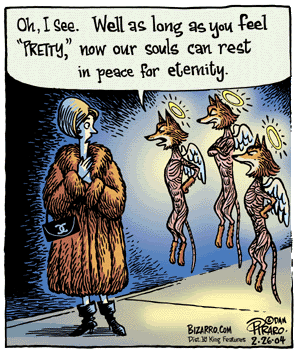
Friday, December 08, 2006
Sneaky, sneaky bastards......
I knew all about the AETA passing, through both the Senate and the House, but I hadn't heard that "President" Bush signed it into law, as of 27 November 2006. For the record, I faxed, phoned, and emailed my Representatives to voice my opposition to the AETA but a fat lot of good it did. My local representative is completely opposite my views. For starters, he's a conservative Republican and I am not.
I happened to stumble onto this bit of news via Will Potter, who writes a great blog and is featured in this month's double-issue of Satya magazine.
Will thoughtfully provides a detailed analysis of the AETA (Animal Enterprise Terrorist Act) which you can read here.
Green is the New Red is a blog I'll be reading everyday, from here on out...
And, finally, two informative sites regarding AETA:
www.noaeta.org
www.stopaeta.org
I knew all about the AETA passing, through both the Senate and the House, but I hadn't heard that "President" Bush signed it into law, as of 27 November 2006. For the record, I faxed, phoned, and emailed my Representatives to voice my opposition to the AETA but a fat lot of good it did. My local representative is completely opposite my views. For starters, he's a conservative Republican and I am not.
I happened to stumble onto this bit of news via Will Potter, who writes a great blog and is featured in this month's double-issue of Satya magazine.
Will thoughtfully provides a detailed analysis of the AETA (Animal Enterprise Terrorist Act) which you can read here.
Green is the New Red is a blog I'll be reading everyday, from here on out...
And, finally, two informative sites regarding AETA:
www.noaeta.org
www.stopaeta.org
Subscribe to:
Posts (Atom)